Showing posts with label automobile industry. Show all posts

Sunday, September 1, 2019

The Last Car Guy

Ferdinand Piëch, who died last week, was perhaps the greatest automotive engineer and automobile executive of the last fifty years. The grandson of Ferdinand Porsche, who designed the Volkswagen Beetle, and the nephew of Ferdinand Anton Ernst Porsche (known as "Ferry" Porsche), who spearheaded the postwar growth of the Porsche sports-car company, he was born for a career in designing and selling cars, and Piëch's taste in cars was quite simple - he only wanted to make the best cars.
Piëch literally began his career in the family business, engineering and designing Porsche race cars that won numerous runs of the 24-hour LeMans race.  He'd come to the company with valuable experience; as a college student at the Swiss Federal Institute of Technology in Zurich, where he studied engineering, he had spent enormous amounts of time adding more power to his own Porsche; he actually took out the heater to make room for more power and drove five hundred kilometers from his family estate in Austria to Zurich, where he went to school, in the bitter cold. Always committed to making improvements on a car design, Piëch was a natural at his family's company, and when he went to Volkswagen's Audi division, he became primarily responsible for turning the marque from an dowdy upper-middle-class brand into a premium brand on the same scale as Mercedes-Benz.  He took that same drive and determination to the chairmanship of Volkswagen AG in 1993, where he increased the market share of Europe's largest automaker and cut costs to bring expenses more in line with the Japanese.  He also added Bentley and Lamborghini to VW's brand empire and brought back the French supercar marque Bugatti. 
Piëch's greatest achievement, though, was nursing VW back to health in North America, where the Japanese had all but decimated the European share of the U.S. and Canadian import market, leaving Volkswagen as the only affordable European car brand in both countries and with a pathetic 0.05 percent U.S. market share.  (Volkswagen sold 3.3 million cars worldwide in 1993 but only sold 49,000 cars in the United States that year - 0.01 percent of its global sales.)  Piëch responded in North America with great products like the Mark 5 Passat sedan and wagon and superb fourth-generation remakes of the Golf and the Jetta.  But it was his championing of the New Beetle, which turned out to be a core product for VW to organize itself around, that saved the day for Volkswagen in the New World.  Piëch, who left the chairmanship in 2002 but remained the head of the Volkswagen advisory board until 2015, proved his point that change comes from great product, not the other way around.  
Piëch's legacy isn't sterling, however.  He was an autocratic manager and a brutal, demanding boss who subscribed to no method other than his own and would not accept anyone who challenged his authority.  This put pressure on VW engineers to meet impossible demands, and many cite Piëch's inflexibility as a reason that the company resorted to cheating on diesel engine emissions.  Piëch had also hired GM-Europe executive José Ignacio López for his cost-cutting expertise, but López had arrived at Volkswagen with a cache full of GM secrets that resulted in a mess of lawsuits and charges against Volkswagen, much to Piëch's embarrassment.  And then there was the Phaeton, that gorgeous luxury sport sedan that had the finest craftsmanship an engineering an Audi could have . . . except that Piëch wanted to market it as a Volkswagen.  It suggested what would happen if General Motors made the finest car possible that could bear the Cadillac name and marketing it as a Chevrolet.  And to be honest, a lot of his cost-cutting measures and his efforts to improve quality haven't gone as well as he might have hoped.  
On balance, though, Piëch's triumphs outweigh his failures.  He was one of the last real automotive geniuses in the car business, most likely the last, a man who, as journalist David Kiley once wrote, had motor oil and axle grease in his veins.  Now that Piëch's veins have run cold, we'll never see another auto kingpin like him.  RIP.    

Saturday, July 6, 2019

Car Guy

Lee Iaccoca, who died this past week at the age of 94, will be remembered as a majestic but flawed automotive genius.  Trained as an engineer, he made his name as a salesman. And one trait balances out the other, given the complex career he had as the president of the Ford Motor Company and the chairman of the Chrysler Corporation.
Iaccoca rose to fame in the sixties when he sought to create a product for Ford's namesake brand that would capture the youth market, and he and Ford product planner Hal Sperlich devised a low-slung, sporty coupe that would be based on the humble Ford Falcon sedan.  That car became the Mustang, and it would soon evolve from a fashion statement into a serious sporting machine, begetting numerous high-performance variations like the Shelby models, the Mustang GT, and the turbo-four-powered Mustang SVO (my favorite), many developed long after Iaccoca left Ford.  The Mustang (the first-generation model shown below with Iaccoca) is now the last passenger car in Ford's North American lineup.  
When he moved to Chrysler, just as the company was dealing with bankruptcy, he went to Washington for a government bailout of $1.5 billion in loan guarantees and caused great skepticism from legislators (including Gary Hart, then representing Colorado in the Senate) who didn't want to sink money in a failing enterprise.  Iaccoca got the loans.  Then he helped bring the compact K-cars - sold as the Dodge Aries and, below, the Plymouth Reliant, then later as the second-generation Chrysler LeBaron - to market, and their basic engineering, ample passenger room, and front-wheel-drive layout made them huge successes and ushered in an era of front-wheel-drive cars that would persist well into the twenty-first century.  On the strength of that success, Chrysler paid back its loans in 1983 - seven years in advance.
Incredibly, small front-wheel-drive sedans were an idea Iaccoca brought to Ford chairman Henry Ford II, who said no to the idea, and Ford nixed another idea suggested by Hal Sperlich - a compact "people mover" car, in the shape of a delivery van, that could fit into a garage.  At Chrysler, where Sperlich was already working when Iaccoca arrived, both men gave the "people mover" project top priority . . . and the modern minivan was born.  Although Dutch auto dealer Ben Pon is regarded as the father of the minivan for suggesting to Volkswagen in the late forties that a van could be built on the Beetle's chassis, it was Chrysler under Iaccoca that made the minivan a mainstream passenger vehicle rather than the funky hipster wagon that the Volkswagen Microbus was.  Below is the Dodge Caravan from its first model year, 1984.
However, Iaccoca also had his blind spots.  Though he rightly gets credit for coming out with the right products at the right time, he staked his reputation on some rather crummy cars as well.  The most notorious example is the Ford Pinto, which became infamous for its gas tank being placed so dangerously close to the rear bumper that a rear-end collision could cause it to explode.  I always wonder why, if Iaccoca felt that a subcompact Ford was necessary for the U.S. market in 1971, he simply didn't have the early-seventies European Escort (not to be confused with the American Ford Escort of the 1980s or 1990s) made here.   
Also, Chrysler's main product under Iaccoca was obviously pedestrian, as the K-cars and the K-car-based minivans were meant to be basic transportation for Middle America.  There's nothing wrong with that.  What was wrong was when Chrysler tried to build different models for different and more exotic market segments.  Iaccoca, recognizing the versatility of the K platform, chose to develop all future models on the same mechanicals that supported a Plymouth Reliant or a Dodge Caravan.  This led to some cars that were automotive poseurs, like the Dodge Daytona sports car, shown below in Turbo Z trim.
Looks pretty slick, huh? Well, appearances can be deceiving.  It's based on the same bland Aries sedan that populated the driveways of America at the time, with the same 135-cubic inch inline four, only the Daytona Z, as you have already gathered, had a turbocharger (but the base model didn't). I entered a contest to win a Daytona when it first debuted as a 1984 model, and I even test-drove one, a mid-level turbo model. Nice ride, but not remarkable.  I wasn't so disappointed when I didn't win one.  (Someone in Georgia did.)
Then Iaccoca tried to convince us that this sedan was worthy of taking on German sport sedans.
The Dodge Lancer looked sort of sharp, and it had a European-style hatchback with a notchback roofline, but under the hood was that same 135-cubic-inch inline four - with a turbocharger, of course - and the car rode on the same basic, bland K platform.  (Which is why Tom and Ray Magliozzi, the hosts of NPR's "Car Talk," once called Iaccoca the "master of smoke and mirrors.")  Many times, to create new cars, Iaccoca had the basic K platform stretched or shortened for longer or shorter wheelbases, respectively, but the engineering remained meat-and-potatoes even when it should been something closer to gourmet.  Iaccoca had a simple strategy - stick with a winning platform, develop all your cars on it for different market segments, and you can't go wrong.  This strategy helped Chrysler do good business for awhile, but it hindered development of newer, more sophisticated platforms and suspension.  Not to mention engines - Chrysler stuck with the same basic four-cylinder engine design throughout the eighties while other manufacturers were developing multiple-cylinder-valve technology and coming up with more advanced fuel injection systems.   
As for luxury cars, Chrysler's experience with them in the Iaccoca age are a mixed bag.  Iaccoca was a product of the 1940s, and his tastes reflected that.  To him, a real luxury car had plush seats, a sumptuous ride, maybe wire wheels or wire-wheel hubcaps, and chrome - lots and lots of chrome.  While he did aim at baby-boomer tastes with cars like the Lancer, his heart was in re-creating the well-appointed luxury cars of Detroit's golden age that his generation had always coveted - and many times he reproduced that glitz and glitter in small packages, like the 1982 LeBaron, and also in one of his big accomplishments - the LeBaron convertible, which arrived on the market six years after the "last" domestic convertible rolled off a Cadillac assembly line.
We all laughed, didn't we? Especially when they came with fake wood paneling, like this 1983 model?  But it brought convertibles back in vogue in a big way and led to other domestic marques - including Cadillac - to introduce new convertibles of their own.  (The 1987 LeBaron convertible featured cleaner styling.)
Iaccoca even brought back the Imperial as a two-door coupe for 1981 on the company's antiquated rear-drive J platform, and though it was a sales flop, it was a beautiful car with an aura of exclusivity to it (Chrysler planned to make only 25,000 Imperial coupes a year but never made more than 9,700 a year in its three years of existence). It was definitely classier than the big coupes Cadillac and Lincoln offered at the time.
Less successful was when Iaccoca tried to make a full-blown land yacht, with all the gaudy touches that implied, out of a smaller car.  Below is the early-nineties Imperial sedan.
Bob Lutz, the legendary auto executive who has worked at all three major American automakers, had an Imperial sedan while at Chrysler, but it was customized to look and feel more European, as Lutz found Iaccoca's tastes to be rather tacky when it came to cars.
Iaccocca was still successful enough to be seriously considered for the Presidency, which he ultimately resisted.  A moderate independent, Iaccoca was a man whose politics were ambiguous but whose identity politics were well-defined; as an Italian-American, his ethnic pride was reflected in some of the decisions he made as Chrysler CEO, like buying Lamborghini (now owned by Volkswagen).  And the less said about the TC, the car he developed with Maserati, the better.
Iacocca's reliance on the tried-and-true could only work for so long, and by the early nineties both he and his cars had turned into parodies of themselves.  Always a star of Chrysler commercials, he began to seem ridiculous with his use of the catchphrase, "If you can find a better car, buy it!" - which was what happened when auto customers found Toyotas.  Quality control at Chrysler was always a problem, and his attempts to invest in defense and aviation companies didn't make the company any more financially secure.  But he ended his tenure as Chrysler chairman on a high note, introducing the LH sedans that pioneered cab-forward design, placing the driver's position farther to the front and creating more passenger room overall.  Also, it featured six-cylinder engines rather than turbo fours.  Below is the 1993 Dodge Intrepid, one of the cars produced on the LH platform.
Some of Iaccoca's accomplishments have been vindicated by time.  The exorbitant amount of money he paid to buy American Motors and acquire its Jeep brand in 1987 raised eyebrows, but it proved to benefit Chrysler in the long run, given the growing (and admittedly insufferable) popularity of SUVs.  And truth be told, the LH sedans would not have been possible without the sophisticated layout of the Premier, the sedan American Motors had developed with Renault before Chrysler inherited it.  He could also be duplicitous, though, as when he promoted the employment of airbags in Chrysler vehicles even though he had opposed federal airbag regulations while at Ford, or the fact that the original Chrysler minivans, while serving most people as station wagons, were registered with the government as trucks so they could comply with fuel economy standards less stringent than those for passenger cars.  (This discrepancy would provide all automakers in the U.S. market with the impetus to push sport utility vehicles over standard cars.)
Also, he had a big ego.  Part of the reason Henry Ford II fired him was because he couldn't stand his desire to be in the center of attention.  This may explain why Hal Sperlich, who, as noted, was instrumental along with Iaccoca in creating Mustangs and minivans, doesn't get the credit for them that he deserves.  But, on balance, Iaccoca was a great and endearing figure in the American automobile industry.  He was patriotic in his devotion to the American car business, and he gave back by leading the foundation that would restore the Statue of Liberty for its centennial and, later Ellis Island, as he was the son of Italian immigrants.  He pushed hard to create good product, he advocated hard work and persistence, and he never stopped believing that Chrysler could be the best car company not just in America but the world, as this old Chrysler commercial from the start of the 1985 model year - one in which he says his sport sedans can compete with the prestigious German marques - demonstrates.
I close with a first-person reminiscence. I admired Lee Iaccoca for his gumption, and I liked some of the cars Chrysler made on his watch.  I too, like many others, thought he should run for President.  But I also had a connection to Iaccoca through two degrees of separation; his friend from his days in his native Pennsylvania, advertising man and sculptor Jay Dugan, was my great-uncle.  I'm sorry my great-uncle Jay never introduced me to Lee Iaccoca, because I know I would have loved talking cars with him.  I might have even made some suggestions to him regarding Chrysler product, and as you can guess from this blog entry, I would have had plenty of them.  But his competitive nature and his drive to succeed, something lacking among us Americans these days, will be as missed as much as Iaccoca himself.  RIP.      

Sunday, July 23, 2017

The Detroit Riot - Fifty Years Later

Can't forget the Motor City.
Fifty years ago today, only eleven days after the rebellion against urban poverty and racism exploded in Newark, Detroit devolved into anarchy like no one had ever seen.  
What had happened in Newark and in other cities transpired in Detroit on a much grander scale.  The city epitomized the American industrial colossus of the mid-twentieth century as the center for automobile production and was seen as a model for other American cities.  It had a vibrant middle class, it had a large percentage of home ownership, and it was even seen as an example of racial harmony.  But persistent societal problems bubbled under the surface, and on July 23, 1967, the plot in Detroit's story began to unravel when police raided an illegal nightclub in a black neighborhood centered around Twelfth Street (now Rosa Parks Boulevard).  The police arrested 82 black revelers celebrating the homecoming of two of their friends.  Angry black residents descended on the scene and looted a nearby store, beginning a week-long citywide disturbance that was an expression of frustration toward deteriorating neighborhoods, chronic unemployment, and police brutality.  When Michigan governor George Romney, a former American Motors CEO, a possible 1968 presidential candidate, and the father of the 2012 Republican presidential nominee, dispatched the state militia to contain the violence, the situation rapidly grew worse, forcing President Lyndon Johnson to send the U.S. Army in.  It was the first time since the War of 1812 that the Army occupied the city.  Ironically, the two black men being welcomed home in that nightclub were GIs who'd just gotten back from the war in Vietnam.
The riot left 39 people dead (including sixteen policemen, militiamen, and soldiers) and 1,189 wounded (including 493 policemen, militiamen and soldiers).
The great irony was that much of Detroit's vitality as a city was in part undone by its most important product - the automobile.   By the late 1960s, federal transportation policy emphasized highways and automobile-based suburbs, which drained most American cities of their predominantly white middle class and left urban centers with a smaller tax base and a higher concentration of poor residents. As in Newark and most other cities, Detroit had seen vibrant neighborhoods replaced by expressways and its public transit system decimated. (General Motors, Detroit's largest company, had been instrumental in tearing out streetcar systems all across America and replacing them with buses, which became the transport mode for only the poor and the indigent.)  Detroit got rich making the cars, but the wealth started flowing outward as many Detroiters packed up their cars and moved to the suburbs.
The city's racial issues evolved as blacks moved from the South to take jobs in the auto industry.  The trickle of black migrants became a steady flow by World War II, when the automakers temporarily stopped making cars and started making tanks and planes for the war effort.  Angry whites, fearing competition from the newcomers, instigated a vicious riot in 1943, but the black population continued to grow.  The automakers continued to offer jobs after war, as the auto industry went in full gear in the late 1940s and 1950s.  The expansion of auto suburbia and the collapse of public transportation in America created more jobs on the assembly lines.  But the number of black migrants soon outpaced the number of new jobs, leaving many in crime-infested neighborhoods with the worst housing, the worst schools, and the least economic opportunity.  The city's political and business establishment did little to accommodate the growing black underclass.  It wasn't long before the frustrations of the black underclass would manifest themselves in a full-scale rebellion.  The riot would be on a scale greater than anyone could have imagined.     
Having seen two vicious race riots within a quarter of a century, white Detroiters followed the example of white Newarkers and white residents of other cities affected by racial conflict - they accelerated a flight from the city that had already been in progress since the end of World War II.  But Detroit had two things going for it - a black middle class that had developed from the black families who settled there between the two world wars and had added to the city's economic vitality, the most obvious example being Berry Gordy's Motown Records, and the still-thriving auto industry that continued to put America on wheels.  In the late sixties, no major American industrial city had more going for it than Detroit.  But that only meant that it had more to lose. 
The American automobile market underwent changes in the seventies that no one at General Motors, Ford or Chrysler saw coming.  Foreign competition, particularly from Japan, became more intense, and when President Richard Nixon supported Israel in the 1973 Yom Kippur War, instigated by the Arab powers, the Arabs cut off oil supplies to the West, producing the first major U.S. energy shortage.  It triggered a decline in all manufacturing, but it affected the automakers more.  Foreign automakers had cars that were easy on suddenly expensive gasoline, and the small, fuel-efficient cars in the domestic car companies' lineups were few . . . and those few were too much of a cosmic joke (the Vega? the Pinto?) to be taken seriously when compared to the high-quality vehicles coming from Toyota and Datsun (the brand name then used by Nissan).  The Big Three would spend the next three decades - decades - trying to turn things around but were still anchored in a corporate culture resistant to meaningful change as foreign carmakers expanded their U.S. operations with improved cars and with factories in other parts of the country.  Even the best-made, most fuel-efficient domestic cars had the most rudimentary technology.  It was a recipe for disaster - both for the domestic auto industry and for Detroit.  (Today the Big Three control about 48 percent of the U.S. car market; General Motors controlled that much alone in 1980.)
Detroit became a black-majority city in the years following the riot, and the city elected its first black mayor, Coleman Young, in 1973.  As mayor, Young walked a tightrope between helping the car companies, whose executives were mostly white, and playing up a militant black-power style that alienated as many people as it attracted. But his twenty-year tenure as mayor left Detroit's finances in a shambles even as the city's fortunes dwindled.  The irony of Young's elevation to City Hall was that he realized political power in Detroit for the city's black population just as the Arab Oil Embargo that set the city and the automakers on a course of decline occurred.
And Berry Gordy had moved Motown to Hollywood to make more money and to make Diana Ross a movie star.
The decline of the once-mighty Motor City is best illustrated by photos of abandoned properties - factories, houses, theaters, parks, whole office buildings, you name it.  The only problem with finding examples is that there are too many to include on this blog.
This picture is of the Packard automobile plant, which closed in 1958, the last year for the Packard brand, which had been bought out by Studebaker.  Studebaker would be gone by 1966.  There are many more abandoned car factories and supplier facilities throughout Detroit, many such places former factories of the car companies that remain.
Here's the Book Tower skyscraper on Washington Boulevard in the downtown area.  Though it's a registered historic landmark, it is abandoned.
The historic Brush Park residential neighborhood, settled by businessmen who made their money in metalworking, meat packing, and other industries before the automakers came along, has a couple of wonderful examples of late-nineteenth-century residential architecture that are in very good shape . . . 
. . . and many more that aren't.

And then there are abandoned theaters like this one, converted into - what else? - a parking garage!
You may have seen pictures of the old Michigan Central railway station, a victim of both urban neglect and disregard for intercity rail in These States.  Here's a photo of the interior.
And here's an example of the splendor of Detroit that is completely gone. Below is a 1940s-era picture of the toy department - yes, the toy department - at Hudson's Department Store, whose founder, Joseph Hudson, invested in the now-defunct car company that would bear his name.  Cultural critic James Howard Kunstler once wrote that Hudson's was "so colossal and posh it made Bloomingdale's look like a five-and-dime."  It's no more,  the store having closed sixteen years after the riot (Bamberger's lasted 25 years after the 1967 Newark riot), and the building having been imploded in 1998 (the Bamberger's building still stands).    
  
As the auto industry struggled in vain to get its groove back, Detroit also tried unsuccessfully to get back on its feet.  Attempts to revive the city with grandiose schemes like the Renaissance Center, a complex of ugly glass towers that eventually became the headquarters of General Motors (even though the project had been pushed by Henry Ford II), were as credible as Lee Iacocca's comparison of sport-sedan versions of the Chrysler LeBaron to BMWs.  Both GM and Chrysler went bankrupt in 2009, GM emerging from it as a smaller company and Chrysler becoming a subsidiary of Italy's Fiat; four years leader it was the city's turn to declare bankruptcy, after years of corruption.  The state of Michigan took over management of the city, effectively putting a black Democratic city under white Republican control, as Republican Rick Snyder was Michigan's governor.  Under an emergency management team, which many feared would force a right-wing agenda on the public-sector workers and their union, Detroit emerged from bankruptcy under local control in December 2014, eliminating $7 billion in debt and investing $1.7 billion into improved city services.
Since then, Detroit has seen improvements not unlike Newark, with many buildings renovated and reused for condominiums and hotels, and its broken streetlights were replaced with new LED lighting. There's even some new light manufacturing, including a watch factory, and Quicken Loans is headquartered there.  And there's also a new streetcar line on Woodward Avenue, built in a partnership with Quicken (more of which later).  Meanwhile, Grand Circus Park, the city's downtown plaza (below), has been fully restored.    
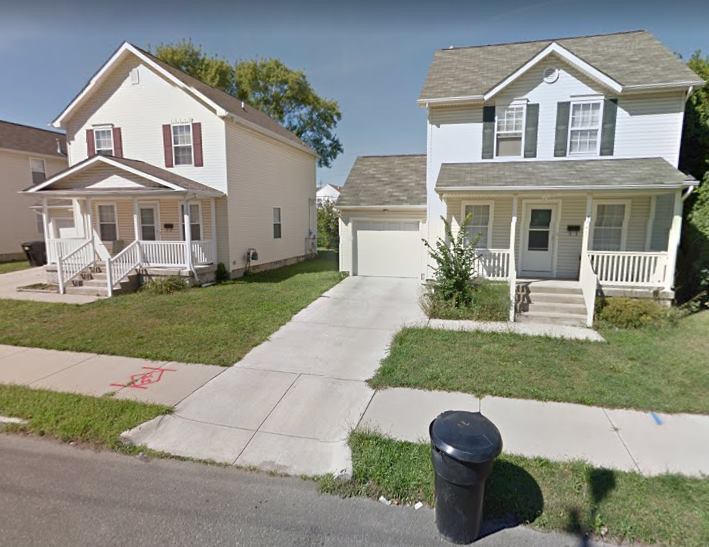
Also, there's new housing construction, such as these houses on Edgewood Avenue.
Alas, there are still many examples of blight side-by-side with new houses, such as Holcomb Avenue, a side street off Edgewood . . . 
. . . as well as this.

This is Eastlawn Street on Detroit's east side, in a block where only one house remains after disinvestment in the area.  It looks like western Ukraine after Chernobyl.  As fate would have it, an accident at a nuclear power plant in Michigan almost endangered Detroit a year before the riot:  "We almost lost Detroit."  But we did indeed lose it.  Unlike Newark, which saw its population increase to 281,764 in 2010 after seven decades of decreases from an all-time peak of 442,337 in 1930, Detroit has seen its population dwindle to about 673,000, without so much as a negligible upward blip in between, from its all-time peak of 1,849,568 in 1950.  In other words, Newark has retained about 64 percent of its all-time peak population; Detroit has lost about 64 percent of its all-time peak population.
The late Coleman Young, who blamed a lot of Detroit's problems on racism, explained the impact of the 1967 insurrection this way: "The riot put Detroit on the fast track to economic desolation, mugging the city and making off with incalculable value in jobs, earnings taxes, corporate taxes, retail dollars, sales taxes, mortgages, interest, property taxes, development dollars, investment dollars, tourism dollars, and plain damn money. The money was carried out in the pockets of the businesses and the white people who fled as fast as they could."  Yes, all of that is true, and racism is a primary reason for Detroit's decline just as it was the reason for the decline of Newark,  but, as I have already tried to make clear, that's not the only reason.  As the primary center for manufacturing the cars that made that flight possible, Detroit was indeed the victim of its own success.  And when the auto industry failed, Detroit failed with it.
"The city that spawned the auto age," James Howard Kunstler wrote, "is the place where everything that could go wrong with a city, did go wrong, in large part because of the car."
In many ways Detroit is the place where America died and went to hell.  The racism and the economic dislocation caused by the aftermath of the riot and the de-industrialization of America led in part to the political divisions we deal with today.  It was Detroit's northern suburbs in Macomb and Oakland counties that saw the rise of "Reagan Democrats" - white working-class registered Democrats that voted for Ronald Reagan for President in 1980 out of anger over the decline of manufacturing and resentment toward a welfare state they believed benefited only racial minorities.  From there it was a logical step to Newt Gingrich, then to the Tea Party and, finally, to Donald J. Trump.  Sad. 
To be fair, Mike Duggan, Detroit's current mayor, has done a lot to bring his city back from the brink. But there's still a long, long way to go.

Thursday, March 16, 2017

Trump Autotopia

Donald Trump swaggered into Michigan yesterday to talk about the American auto industry - one of many subjects in which he is no way familiar.
He announced that he was going to review and likely roll back corporate average fuel economy (CAFE) standards that sets a benchmark of 54.5 miles a gallon by 2025.  This means less incentive for automakers to develop hybrid vehicles, and electric and fuel-cell models, as well as cars like the Chevrolet Volt (ironically, one of the many cars Trump looked at while in Michigan), and, oh yes, less of an incentive to produce small cars.
My next car may have to be a gas guzzler, because that's all I'll be able to buy.
The domestic automakers are, of course, pleased that the CAFE standards are likely to be reversed, because that means they'll be able to avoid responsibility for making environmentally friendly products and be able to continue making cheap, crude SUVs and pickups and underdeveloped sedans rather than come up with more innovative cars that can compete in the market more effectively.
"There is no more beautiful sight than an American-made car," said Trump, who's obviously never seen a Porsche.  He promised that Detroit would "once again shine with industrial might" and decried the "massive shipments" of foreign cars dumped on American consumers.  Oh yeah, while in Michigan, he'd had a round-table discussion with car company executives that, in addition to General  Motors CEO Mary Barra and Ford CEO Mark Fields, also included Sergio Marchionne, the CEO of the Italian company that owns Chrysler (Fiat Chrysler Automobiles), as well as Nissan North America Chairman Jose Munoz (Nissan - a Japanese company owned by Renault of France) and Jerry Flannery of Hyundai (a South Korean company).  Trump said of the foreign automakers with plants in the United States, "We love them too."  Not too many of them have American facilities in Michigan, though. 
Trump was essentially promising to bring the auto industry in the U.S. back to 1950s levels, even though back then there had been little industrial competition from overseas and looser regulations that discouraged continuous improvement and encouraged flashy, superficial model changes - thus, Detroit ended up using rudimentary technology that persisted will into the 1980s.  He also said that the assault on the American auto industry is over, leading me to wonder what he was talking about.  Because as I recall, it was Barack Obama who saved GM and Chrysler by investing taxpayers' money in them (which got paid back to the government) and helping them through bankruptcy, preserving thousands of auto jobs and many other jobs connected to the auto industry. 
Trump also promised that, under his Presidency, Detroit would become "the car capital of the world again."  Umm, didn't he realize that, again, Chrysler is a subsidiary of an Italian company and that, umm, GM just sold all of its European assets to a car company based in France?  Is that how Detroit becomes the car capital of the world - with Ford being the only U.S.-based car company having something resembling a truly global presence?
One thing is for certain - given Trump's history in business, we should be glad that he never ran a car company.  And I'm sorry Tesla founder Elon Musk - a South African immigrant - can't run for President.  Because he's a CEO I'd vote for! 

Wednesday, December 23, 2009

Volvo Sale A Safe Bet

Ford is selling the Swedish car manufacturer Volvo, which it bought for $6.45 billion in 1999, to the Chinese auto company Geely for a about third of what Ford paid for it. Volvo has been losing money lately, and Ford is focusing more on its namesake brand both in North America and Europe. Ford will still have a stake in Volvo, though; much of the technology and safety features Ford and its Swedish subsidiary have developed is included in Ford vehicles, so it will be able to continue to share components with Volvo for awhile.
It's a win-win situation for everyone, helping Ford becoming a leaner company while allowing the continued collaboration with Volvo and allowing the Volvo brand to be introduced to Chinese consumers.
To those auto enthusiasts who see this deal as the automotive equivalent of dipping herring in sweet and sour sauce, put a Swedish meatball in it. Volvo is a brand with a long and honored tradition of making the safest cars on the planet (not necessarily the most durable cars on the planet anymore, but that's another story). I'd rather see a thriving Chinese-owned Volvo company than a dead Swedish one. Didn't you hear about Saab? :-(

Monday, November 2, 2009

Strong As a Bull

The Ford Motor Company surprised everyone by posting a billion-dollar profit for the third quarter of 2009. This proves that Ford's business decisions, dating back to their restructuring of a few years ago, are beginning to pay off. The company managed to avoid bankruptcy and produce some fine product - Ford cars are the best-made domestic cars right now - and they had fuel-efficient automobiles on the market during the "cash for clunkers" program when GM and Chrysler had few models in that market segment. Also, they continue to receive a lot of goodwill from car buyers by not taking federal bailout money.
Ford still has a few problems. They can't wipe out their debts the way GM and Chrysler did in Chapter 11, and getting unions to make concessions designed to cut costs hasn't been easy. But the way forward, as their restructuring plan was called, sounds more like a real plan of action than a slogan.
I happen to like the new Taurus. :-)