Can't forget the Motor City.
Fifty years ago today, only eleven days after the rebellion against urban poverty and racism exploded in Newark, Detroit devolved into anarchy like no one had ever seen.
What had happened in Newark and in other cities transpired in Detroit on a much grander scale. The city epitomized the American industrial colossus of the mid-twentieth century as the center for automobile production and was seen as a model for other American cities. It had a vibrant middle class, it had a large percentage of home ownership, and it was even seen as an example of racial harmony. But persistent societal problems bubbled under the surface, and on July 23, 1967, the plot in Detroit's story began to unravel when police raided an illegal nightclub in a black neighborhood centered around Twelfth Street (now Rosa Parks Boulevard). The police arrested 82 black revelers celebrating the homecoming of two of their friends. Angry black residents descended on the scene and looted a nearby store, beginning a week-long citywide disturbance that was an expression of frustration toward deteriorating neighborhoods, chronic unemployment, and police brutality. When Michigan governor George Romney, a former American Motors CEO, a possible 1968 presidential candidate, and the father of the 2012 Republican presidential nominee, dispatched the state militia to contain the violence, the situation rapidly grew worse, forcing President Lyndon Johnson to send the U.S. Army in. It was the first time since the War of 1812 that the Army occupied the city. Ironically, the two black men being welcomed home in that nightclub were GIs who'd just gotten back from the war in Vietnam.
The riot left 39 people dead (including sixteen policemen, militiamen, and soldiers) and 1,189 wounded (including 493 policemen, militiamen and soldiers).

The great irony was that much of Detroit's vitality as a city was in part undone by its most important product - the automobile. By the late 1960s, federal transportation policy emphasized highways and automobile-based suburbs, which drained most American cities of their predominantly white middle class and left urban centers with a smaller tax base and a higher concentration of poor residents. As in Newark and most other cities, Detroit had seen vibrant neighborhoods replaced by expressways and its public transit system decimated. (General Motors, Detroit's largest company, had been instrumental in tearing out streetcar systems all across America and replacing them with buses, which became the transport mode for only the poor and the indigent.) Detroit got rich making the cars, but the wealth started flowing outward as many Detroiters packed up their cars and moved to the suburbs.
The city's racial issues evolved as blacks moved from the South to take jobs in the auto industry. The trickle of black migrants became a steady flow by World War II, when the automakers temporarily stopped making cars and started making tanks and planes for the war effort. Angry whites, fearing competition from the newcomers, instigated a vicious riot in 1943, but the black population continued to grow. The automakers continued to offer jobs after war, as the auto industry went in full gear in the late 1940s and 1950s. The expansion of auto suburbia and the collapse of public transportation in America created more jobs on the assembly lines. But the number of black migrants soon outpaced the number of new jobs, leaving many in crime-infested neighborhoods with the worst housing, the worst schools, and the least economic opportunity. The city's political and business establishment did little to accommodate the growing black underclass. It wasn't long before the frustrations of the black underclass would manifest themselves in a full-scale rebellion. The riot would be on a scale greater than anyone could have imagined.

Having seen two vicious race riots within a quarter of a century, white Detroiters followed the example of white Newarkers and white residents of other cities affected by racial conflict - they accelerated a flight from the city that had already been in progress since the end of World War II. But Detroit had two things going for it - a black middle class that had developed from the black families who settled there between the two world wars and had added to the city's economic vitality, the most obvious example being Berry Gordy's Motown Records, and the still-thriving auto industry that continued to put America on wheels. In the late sixties, no major American industrial city had more going for it than Detroit. But that only meant that it had more to lose.
The American automobile market underwent changes in the seventies that no one at General Motors, Ford or Chrysler saw coming. Foreign competition, particularly from Japan, became more intense, and when President Richard Nixon supported Israel in the 1973 Yom Kippur War, instigated by the Arab powers, the Arabs cut off oil supplies to the West, producing the first major U.S. energy shortage. It triggered a decline in all manufacturing, but it affected the automakers more. Foreign automakers had cars that were easy on suddenly expensive gasoline, and the small, fuel-efficient cars in the domestic car companies' lineups were few . . . and those few were too much of a cosmic joke (the Vega? the Pinto?) to be taken seriously when compared to the high-quality vehicles coming from Toyota and Datsun (the brand name then used by Nissan). The Big Three would spend the next three decades - decades - trying to turn things around but were still anchored in a corporate culture resistant to meaningful change as foreign carmakers expanded their U.S. operations with improved cars and with factories in other parts of the country. Even the best-made, most fuel-efficient domestic cars had the most rudimentary technology. It was a recipe for disaster - both for the domestic auto industry and for Detroit. (Today the Big Three control about 48 percent of the U.S. car market; General Motors controlled that much alone in 1980.)
Detroit became a black-majority city in the years following the riot, and the city elected its first black mayor, Coleman Young, in 1973. As mayor, Young walked a tightrope between helping the car companies, whose executives were mostly white, and playing up a militant black-power style that alienated as many people as it attracted. But his twenty-year tenure as mayor left Detroit's finances in a shambles even as the city's fortunes dwindled. The irony of Young's elevation to City Hall was that he realized political power in Detroit for the city's black population just as the Arab Oil Embargo that set the city and the automakers on a course of decline occurred.
And Berry Gordy had moved Motown to Hollywood to make more money and to make Diana Ross a movie star.
The decline of the once-mighty Motor City is best illustrated by photos of abandoned properties - factories, houses, theaters, parks, whole office buildings, you name it. The only problem with finding examples is that there are too many to include on this blog.
This picture is of the Packard automobile plant, which closed in 1958, the last year for the Packard brand, which had been bought out by Studebaker. Studebaker would be gone by 1966. There are many more abandoned car factories and supplier facilities throughout Detroit, many such places former factories of the car companies that remain.
Here's the Book Tower skyscraper on Washington Boulevard in the downtown area. Though it's a registered historic landmark, it is abandoned.
The historic Brush Park residential neighborhood, settled by businessmen who made their money in metalworking, meat packing, and other industries before the automakers came along, has a couple of wonderful examples of late-nineteenth-century residential architecture that are in very good shape . . .

. . . and many more that aren't.
And then there are abandoned theaters like this one, converted into - what else? - a parking garage!
You may have seen pictures of the old Michigan Central railway station, a victim of both urban neglect and disregard for intercity rail in These States. Here's a photo of the interior.
And here's an example of the splendor of Detroit that is completely gone. Below is a 1940s-era picture of the toy department - yes, the toy department - at Hudson's Department Store, whose founder, Joseph Hudson, invested in the now-defunct car company that would bear his name. Cultural critic James Howard Kunstler once wrote that Hudson's was "so colossal and posh it made Bloomingdale's look like a five-and-dime." It's no more, the store having closed sixteen years after the riot (Bamberger's lasted 25 years after the 1967 Newark riot), and the building having been imploded in 1998 (the Bamberger's building still stands).

As the auto industry struggled in vain to get its groove back, Detroit also tried unsuccessfully to get back on its feet. Attempts to revive the city with grandiose schemes like the Renaissance Center, a complex of ugly glass towers that eventually became the headquarters of General Motors (even though the project had been pushed by Henry Ford II), were as credible as Lee Iacocca's comparison of sport-sedan versions of the Chrysler LeBaron to BMWs. Both GM and Chrysler went bankrupt in 2009, GM emerging from it as a smaller company and Chrysler becoming a subsidiary of Italy's Fiat; four years leader it was the city's turn to declare bankruptcy, after years of corruption. The state of Michigan took over management of the city, effectively putting a black Democratic city under white Republican control, as Republican Rick Snyder was Michigan's governor. Under an emergency management team, which many feared would force a right-wing agenda on the public-sector workers and their union, Detroit emerged from bankruptcy under local control in December 2014, eliminating $7 billion in debt and investing $1.7 billion into improved city services.
Since then, Detroit has seen improvements not unlike Newark, with many buildings renovated and reused for condominiums and hotels, and its broken streetlights were replaced with new LED lighting. There's even some new light manufacturing, including a watch factory, and Quicken Loans is headquartered there. And there's also a new streetcar line on Woodward Avenue, built in a partnership with Quicken (more of which later). Meanwhile, Grand Circus Park, the city's downtown plaza (below), has been fully restored.
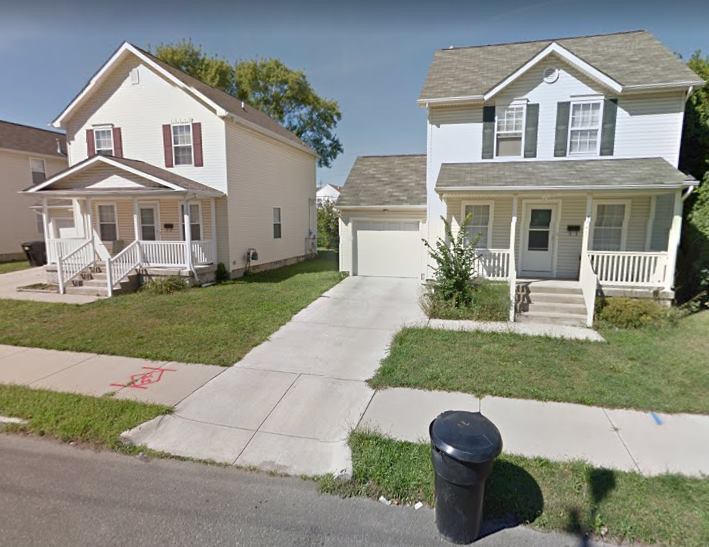
Also, there's new housing construction, such as these houses on Edgewood Avenue.
Alas, there are still many examples of blight side-by-side with new houses, such as Holcomb Avenue, a side street off Edgewood . . .
. . . as well as this.
This is Eastlawn Street on Detroit's east side, in a block where only one house remains after disinvestment in the area. It looks like western Ukraine after Chernobyl. As fate would have it, an accident at a nuclear power plant in Michigan almost endangered Detroit a year before the riot: "We almost lost Detroit." But we did indeed lose it. Unlike Newark, which saw its population increase to 281,764 in 2010 after seven decades of decreases from an all-time peak of 442,337 in 1930, Detroit has seen its population dwindle to about 673,000, without so much as a negligible upward blip in between, from its all-time peak of 1,849,568 in 1950. In other words, Newark has retained about 64 percent of its all-time peak population; Detroit has lost about 64 percent of its all-time peak population.
The late Coleman Young, who blamed a lot of Detroit's problems on racism, explained the impact of the 1967 insurrection this way: "The riot put Detroit on the fast track to economic desolation, mugging the city and making off with incalculable value in jobs, earnings taxes, corporate taxes, retail dollars, sales taxes, mortgages, interest, property taxes, development dollars, investment dollars, tourism dollars, and plain damn money. The money was carried out in the pockets of the businesses and the white people who fled as fast as they could." Yes, all of that is true, and racism is a primary reason for Detroit's decline just as it was the reason for the decline of Newark, but, as I have already tried to make clear, that's not the only reason. As the primary center for manufacturing the cars that made that flight possible, Detroit was indeed the victim of its own success. And when the auto industry failed, Detroit failed with it.
"The city that spawned the auto age," James Howard Kunstler wrote, "is the place where everything that could go wrong with a city, did go wrong, in large part because of the car."
In many ways Detroit is the place where America died and went to hell. The racism and the economic dislocation caused by the aftermath of the riot and the de-industrialization of America led in part to the political divisions we deal with today. It was Detroit's northern suburbs in Macomb and Oakland counties that saw the rise of "Reagan Democrats" - white working-class registered Democrats that voted for Ronald Reagan for President in 1980 out of anger over the decline of manufacturing and resentment toward a welfare state they believed benefited only racial minorities. From there it was a logical step to Newt Gingrich, then to the Tea Party and, finally, to Donald J. Trump. Sad.
To be fair, Mike Duggan, Detroit's current mayor, has done a lot to bring his city back from the brink. But there's still a long, long way to go.




 Posts
Posts

