"Mr. Spaceman" by the Byrds (Go to the link in the upper-right-hand corner.)
Showing posts with label 1967. Show all posts
Showing posts with label 1967. Show all posts
Friday, April 3, 2026

Friday, March 31, 2023
Music Video Of the Week - March 31, 2023
"Friday On My Mind" by the Easybeats (Go to the link in the upper-right-hand corner.)
Sunday, November 27, 2022
The Jimi Hendrix Experience - Are You Experienced (1967)

Is Are You Experienced the greatest debut rock album of all time?
Let me answer that question by putting Jimi Hendrix's maiden long player in proper perspective. To understand just how revolutionary Are You Experienced was when it was released in 1967, consider everything that came before it. Rock and roll had mostly been two-to-three-minute songs with carefully structured verses and choruses and arrangements that were conventionally concocted with limited re-imagination of instrumental variety and sonic quality. Sure, the Beatles would add backward tapes or double string quartets, as well as the odd non-Western instrument, and Brian Wilson would produce some sumptuous orchestrations, but rock was mostly carried by straightforward guitar riffs meant to dance to. Are You Experienced changed all that. Overnight, rock went from teenybopper love songs and what Phil Spector had once called "little symphonies for the kids" to free-form, blues-based, edgy chord progressions and improvisations that would form the foundation of the heavy-metal and hard rock to come - and it was all from this album. AOR radio as it existed in the 1970s couldn't have been possible without Hendrix and his unprecedented approach to guitar playing. Furthermore, he made it clear that the innovative rock guitar sounds that had come before would no longer do. Not only would Hendrix teach future legends like Eddie Van Halen and Saul "Slash" Hudson how to play guitar without ever meeting them, he re-educated peers like Stephen Stills and Johnny Winter.
Are You Experienced came out in two separate editions in the U.S. and the U.K. - the American edition opened with "Purple Haze" and the British version opened with "Foxy Lady" - but whether you were a Yank who first heard the menacing riff of the former song or a Brit who first heard the sexaully searing guitar riff of the latter, you knew this record offered something incredibly new. And Are You Experienced delivers - still - to younger generations not experienced with Hendrix, just as it stands up to repeated listenings for those who discovered him earlier. Charging riffs, rapid-fire solos and intricate note progressions come to the fore in songs like "Manic Depression," "Love or Confusion," "Fire" and the soldering blues cut "Hey Joe," all delivered with Hendrix's direct vocal style that is as piercing as his guitar. He proved himself adaptable at more low-key songs, inventing the modern rock ballad with "The Wind Cries Mary" and its evocative imagery and the gorgeous yet powerful "May This Be Love," both flowing with thoughtful solos and fills. Hendrix's visions are transformed into brilliant reality by the scattershot drums of Mitch Mitchell and the galloping bass of Noel Redding, anchoring Jimi's free-form improvisations and deep explorations of blues and soul with aplomb. The three of them go even deeper with the majestic soundscape "Third Rock From the Sun," in which Hendrix goes completely experimental and finds new ways to make music from his guitar that don't involve a fretboard.
The pièce de résistance of Are You Experienced is the title track, in which Hendrix encapsulates every innovation that mad him beyond great; feedback arranged with great complexity, lightning-speed fingerings on the backward guitar solo, heavy distortion, and an a persistent ringing sound that sounds like a department store chime - all done around one chord. It's fitting that the album ends with this song, because as it fades out - and comes back briefly to close Are You Experienced on a definitive note - you're in an altered state that you, like rock and roll fans and aspiring rock musicians in 1967 and beyond, never really leave.
Not necessarily stoned, but . . . beautiful.
(The 1997 reissues of Are You Experienced features the U.S. album plus three single-release songs, including the defiant "Stone Free", plus the three songs that made it on the original U.K. edition, including Hendrix's only (alas!) twelve-bar blues, "Red House.")
Friday, November 25, 2022
Music Video Of the Week - November 25, 2022
"Hey Joe" by the The Jimi Hendrix Experience (Go to the link in the upper-right-hand corner.)
Friday, April 20, 2018
Music Video Of the Week - April 20, 2018
"(Sittin' On) The Dock of the Bay" by Otis Redding (Go to the link in the upper-right-hand corner.)
Friday, March 9, 2018
Music Video Of the Week - March 9, 2018
"By the Time I Get to Phoenix" by Glen Campbell (Go to the link in the upper-right-hand corner.)
Friday, January 26, 2018
Music Video Of the Week - January 26, 2018
"Green Tambourine" by the Lemon Pipers (Go to the link in the upper-right-hand corner.)
Friday, January 19, 2018
Music Video Of the Week - January 19, 2018
"Judy In Disguise (With Glasses)" by John Fred & His Playboy Band (Go to the link in the upper-right-hand corner.)

:-D
Friday, January 5, 2018
Music Video Of the Week - January 5, 2018
"The Fool On the Hill" by the Beatles (Go to the link in the upper-right-hand corner.)
Wednesday, December 27, 2017
Dylan's Three Kings
Fifty years ago today, Bob Dylan released his long-awaited followup to his Blonde on Blonde double album . . . the spectacularly great low-key album John Wesley Harding, which I already reviewed on my blog. In celebration of this milestone, I present the liner notes of John Wesley Harding - written by Dylan - which are as essential as the record itself.
*
There were three kings and a jolly three too. The first one had a broken nose, the second, a broken arm and the third was broke. "Faith is the key!" said the first king. "No, froth is the key!" said the second. "You're both wrong," said the third, "the key is Frank!"
It was late in the evening and Frank was sweeping up, preparing the meat and dishing himself out when there came a knock upon the door. "Who is it?" he mused. "It's us, Frank," said the three kings in unison, "and we'd like to have a word with you!" Frank opened the door and the three kings crawled in.
Terry Shute was in the midst of prying open a hairdresser when Frank's wife came in and caught him. "They're here!" she gasped. Terry dropped his drawer and rubbed the eye. "What do they appear to be like?" "One's got a broken vessel and that's the truth, the other two I'm not so sure about." "Fine, thank you, that'll be all." "Good" she turned and puffed. Terry tightened his belt and in an afterthought, stated: "Wait!" "Yes?" "How many of them would you say there were?" Vera smiled, she tapped her toe three times. Terry watched her foot closely. "Three?" he asked, hesitating. Vera nodded.
"Get up off my floor!" shouted Frank. The second king, who was first to rise, mumbled, "Where's the better half, Frank?" Frank, who was in no mood for jokes, took it lightly, replied, "She's in the back of the house, flaming it up with an arrogant man, now come on, out with it, what's on our minds today?" Nobody answered.
Terry Shute then entered the room with a bang, looking the three kings over and fondling his mop. Getting down to the source of things, he proudly boasted: "There is a creeping consumption in the land. It begins with these three fellas and it travels outward. Never in my life have I seen such a motley crew. They ask nothing and they receive nothing. Forgiveness is not in them. The wilderness is rotten all over their foreheads. They scorn the widow and abuse the child but I am afraid that they shall not prevail over the young man's destiny, not even them!" Frank turned with a blast, "Get out of here, you ragged man! Come ye no more!" Terry left the room willingly.
"What seems to be the problem?" Frank turned back to the three kings who were astonished. The first king cleared his throat. His shoes were too big and his crown was wet and lopsided but nevertheless, he began to speak in the most meaningful way, "Frank," he began, "Mr. Dylan has come out with a new record. This record of course features none but his own songs and we understand that you're the key." "That's right," said Frank, "I am." "Well then," said the king in a bit of excitement, "could you please open it up for us?" Frank, who all this time had been reclining with his eyes closed, suddenly opened them both up as wide as a tiger. "And just how far would you like to go in?" he asked and the three kings all looked at each other. "Not too far but just far enough so's we can say that we've been there," said the first chief. "All right," said Frank, "I'll see what I can do," and he commenced to doing it. First of all, he sat down and crossed his legs, then he sprung up, ripped off his shirt and began waving it in the air. A lightbulb fell from one of his pockets and he stamped it out with his foot. Then he took a deep breath, moaned and punched his fist through the plate-glass window. Settling back in his chair, he pulled out a knife, "Far enough?" he asked. "Yeah, sure, Frank," said the second king. The third king just shook his head and said he didn't know. The first king remained silent. The door opened and Vera stepped in. "Terry Shute will be leaving us soon and he desires to know if you kings got any gifts you wanna lay on him." Nobody answered.
It was just before the break of day and the three kings were tumbling along the road. The first one's nose had been mysteriously fixed, the second one's arm had healed and the third one was rich. All three of them were blowing horns. "I've never been so happy in all my life!" sang the one with all the money.
"Oh mighty thing!" said Vera to Frank, "Why didn't you just tell them you were a moderate man and leave it at that instead of goosing yourself all over the room?" "Patience, Vera," said Frank. Terry Shute, who was sitting over by the curtain cleaning an ax, climbed to his feet, walked over to Vera's husband and placed his hand on his shoulder. "Yuh didn't hurt yer hand, didja Frank?" Frank just sat there watching the workmen replace the window. "I don't believe so," he said.

Tuesday, December 26, 2017
'Magical Mystery Tour' - Fifty Years
Fifty years ago today, the British Broadcasting Corporation's television channel BBC1 debuted the Beatles' first and only television movie Magical Mystery Tour. It was their first - and again, only - unqualified failure.

Magical Mystery Tour was an experimental musical film that the Beatles wrote, produced and directed themselves, despite knowing next to nothing about making movies before this. It was in part a desire to express themselves on screen without the help of intermediaries like Richard Lester and Walter Shenson, the respective director and producer of their first two theatrically released movies. But it was also an earnest effort to explore artistic media other than records.
It was Paul McCartney who first conceived the idea of the Beatles making a film for TV. Paul had been experimenting with film and had been making avant-garde shorts in his spare time, and he thought that it would be pretty cool for the Beatles to do something similar for the tube. Though John Lennon had his doubts, he was by no means averse to experimental cinema. He and friend and Beatles collaborator Victor Spinetti, who'd starred with the Beatles in A Hard Day's Night and Help!, sat through two successive screenings of the Luis Buñuel 1967 movie Belle De Jour checking out Buñuel's camera angles and use of color (and no doubt also checking out the film's star, Catherine Deneuve, but that's another issue). Besides, as John later remembered, the Beatles had given up touring and even one-night-only concerts, and "if stage shows were to be out, we wanted something to replace them. Television was the obvious answer." George Harrison and Ringo Starr were also game. So the plan preceded.
The premise of the film was based on the mystery tour, a popular diversion for the English working class at the time. The idea was simple; you got on a bus, you had no idea where you were going or what route you were taking, and you only found out were you were going once you got there. In the north of England, that usually meant taking a coach trip to the seaside resort of Blackpool, where tour goers would watch the city's annual light display and get drunk. But it was the antics of a group of American hippies that the Beatles hoped would provide the inspiration for the magic - Ken Kesey and his Merry Pranksters, who rode in a psychedelic-painted school bus drinking Kool-Aid spiked with LSD and recording their visions on the trip, a practice later documented by Tom Wolfe in his book "The Electric Kool-Aid Acid Test." Paul McCartney hoped that the Beatles, all of whom were tripping on a regular basis in 1967, could capture on film the same sort of visions they captured in music. The film was to be aired during, believe it or not, Christmas time; the Beatles thought that Magical Mystery Tour could be a hip holiday special in contrast to the straight holiday fare that performers like Frank Sinatra and Bing Crosby had made for American television. It would be aired by the BBC on the day after Christmas, celebrated by the Brits as Boxing Day.
The first Beatles project released after the death of Beatles manager Brian Epstein, Magical Mystery Tour was planned as soon as work on Sgt. Pepper was wrapping up. Paul wrote the title song in early 1967 and the Beatles recorded it that April. Work began on the soundtrack record in earnest in August 1967, just before Epstein's death; by a strange coincidence, Epstein attended a recording session for the soundtrack on Wednesday, August 23, that turned out to be the last Beatles recording session before his death on Sunday, August 27. Though Epstein would be in a cheerful mood a couple of days after the session in anticipation of his planned visit to America for the following month, he wasn't in good spirits that Wednesday night. It's as if he could see what was going to happen.

There was no real script. The Beatles simply rented a bus, invited friends, actors, circus performers and a little girl named Nicola (now known as Nikki Hale and living in a Chicago suburb - really!), and they all rode around Devon and Cornwall for two weeks in September 1967 filming as they went. Additional filming took place into October, and recording sessions for the songs in the film continued concurrently. The ideas for the film ranged from John shoveling spaghetti on a plate in a restaurant (based on a dream he had) and Ringo driving the bus in a track race to all of the passengers entering a pup tent at once and the male passengers stopping at a club to watch a woman strip while the Bonzo Dog Doo Dah Band perform a teen-tragedy parody song about a young woman who dies in a taxi crash, called "Death Cab For Cutie." (Yes, this is where that indie-rock band got its name.) Victor Spinetti got into the act by playing a drill sergeant trying to get the tour party to join the army. As you can gather, there was no plot and little suspense, unlike in A Hard Day's Night and Help!; the group was improvising a basic trajectory from a beginning to an end. The songs in Magical Mystery Tour, meanwhile, are interspersed throughout as surreal vignettes ("I Am the Walrus" in a weird musical land of anthropomorphic creatures and city policemen all in a row, for example), with five magicians in the sky (played by the Beatles and Beatles assistant Mal Evans) directing the tour. It all ends with a Busby Berkeley-style sequence with the Beatles in white suits (below) performing "Your Mother Should Know."

"We filled it in as we went along," John Lennon later said. "We knew most of the scenes we wanted to include, but we bent our ideas to fit the people concerned, once we got to know our cast. If somebody wanted to do something we hadn’t planned, they went ahead. If it worked, we kept it in."
Magical Mystery Tour aired for the first time on BBC1 on Boxing Day, Tuesday, December 26, 1967, drawing fifteen million Britons - 27 percent of the British population at the time - to watch. The Beatles were hugely successful at getting people to tune in, but after 52 minutes of their self-indulgence and aimless camera and storyline experiments that seemed neither magical nor mysterious, the Brits turned off and dropped out. The following day, the Daily Express's television critic got front-page space for his review - "I cannot ever remember seeing such blatant rubbish." (To understand how devastating that is, just say "blatant rubbish" in a pompous British accent.) Other reviewers, none of whom obviously got to screen it in advance, called it "appalling," "chaotic," and "a colossal conceit." The band Traffic - which actually filmed a sequence for the movie - could breathe a collective sigh of relief knowing that they'd been edited out of it.
To be fair, the film was aired on the wrong channel. Magical Mystery Tour's raison d'etre was the Beatles' use of color, in all of its forms; the sequence for their instrumental "Flying," the first of only a few original compositions credited to all four Beatles, was presented with colorized images of clouds from a black-and-white Stanley Kubrick film. Ironically, TV viewers could only see them in black-and-white - BBC1 didn't broadcast in color at the time. Magical Mystery Tour was aired on the color channel BBC2 on January 5, 1968, but between the day after Christmas and the eve of the Feast of the Epiphany, the Brits had already abandoned the idea of giving Magical Mystery Tour a second chance.
An American TV deal was cancelled on the basis of the reaction to the British airing, so Magical Mystery Tour became the musical equivalent of Cuban cigars in the United States - forbidden fruit, something so rare and unattainable that you had to seek it out for yourself. Unlike Cuban cigars, which have a stellar reputation, Magical Mystery Tour had such a bad reputation that Americans seeking it out went in to it with low expectations, anticipating that it would be bad but also asking how bad it could possibly be. It became a cult item, first being shown twice at the Fillmore East in New York in 1968, later being given limited theatrical release in the seventies and then occasionally popping up at 1:30 in the morning on local TV. Many American Beatles fans come away from Magical Mystery Tour with a different appraisal than their British counterparts - yes, it's bad, but it's not horrible enough to warrant all the criticism it got from British audiences back in 1967. Americans see it in ironic terms - it's so bad, it's good. Some Americans have even come away from it with a sense of sincere appreciation; Steven Spielberg has praised the camera angles and use of color in the movie, and he cites it as an influence. Magical Mystery Tour's very elusiveness in These States has allowed the film to hold up better in the U.S. than it did in the U.K., where its failure with the press and the public led Paul McCartney to admit that "we goofed really."

As it turned out, those foolish Beatles on the hill proved to be wiser than those who scorned them. Magical Mystery Tour actually broke new ground for rock and roll, as other rockers took this sad song of an idea and, well, made it better. The following year, 1968, the Monkees made the trippy theatrical movie Head; ironically, fans and critics consider this Magical Mystery Tour copy from the prefabricated Beatles copycats to be the superior movie. Also in 1968, the one man who inspired the Beatles more than any other, Elvis Presley, made the definitive rock and roll Christmas special, aired on NBC that December 3. So even in failure, the Beatles succeeded.
Goo goo g'joob!
Magical Mystery Tour was finally aired on American national television on December 14, 2012, on PBS, the closest thing the United States has to the BBC, with a documentary on the making of the film preceding it.
Full circle.
Friday, November 24, 2017
Music Video Of the Week - November 24, 2017
"Hello Goodbye" by the Beatles (Go to the link in the upper-right-hand corner.)
Friday, November 10, 2017
Music Video Of the Week - November 10, 2017
"Strange Brew" by Cream (Go to the link in the upper-right-hand corner.)
Friday, September 1, 2017
Music Video Of the Week - September 1, 2017
"Are You Experienced?" by Jimi Hendrix (Go to the link in the upper-right-hand corner.)
Friday, August 11, 2017
Music Video Of the Week - August 11, 2017
"Gentle On My Mind" by Glen Campbell and John Hartford (Go to the link in the upper-right-hand corner.)
Friday, August 4, 2017
Music Video Of the Week - August 4, 2017
"Ain't No Mountain High Enough" by Marvin Gaye and Tammi Terrell (Go to the link in the upper-right-hand-corner.)
Sunday, July 23, 2017
The Detroit Riot - Fifty Years Later
Can't forget the Motor City.

Fifty years ago today, only eleven days after the rebellion against urban poverty and racism exploded in Newark, Detroit devolved into anarchy like no one had ever seen.
What had happened in Newark and in other cities transpired in Detroit on a much grander scale. The city epitomized the American industrial colossus of the mid-twentieth century as the center for automobile production and was seen as a model for other American cities. It had a vibrant middle class, it had a large percentage of home ownership, and it was even seen as an example of racial harmony. But persistent societal problems bubbled under the surface, and on July 23, 1967, the plot in Detroit's story began to unravel when police raided an illegal nightclub in a black neighborhood centered around Twelfth Street (now Rosa Parks Boulevard). The police arrested 82 black revelers celebrating the homecoming of two of their friends. Angry black residents descended on the scene and looted a nearby store, beginning a week-long citywide disturbance that was an expression of frustration toward deteriorating neighborhoods, chronic unemployment, and police brutality. When Michigan governor George Romney, a former American Motors CEO, a possible 1968 presidential candidate, and the father of the 2012 Republican presidential nominee, dispatched the state militia to contain the violence, the situation rapidly grew worse, forcing President Lyndon Johnson to send the U.S. Army in. It was the first time since the War of 1812 that the Army occupied the city. Ironically, the two black men being welcomed home in that nightclub were GIs who'd just gotten back from the war in Vietnam.
The riot left 39 people dead (including sixteen policemen, militiamen, and soldiers) and 1,189 wounded (including 493 policemen, militiamen and soldiers).

The great irony was that much of Detroit's vitality as a city was in part undone by its most important product - the automobile. By the late 1960s, federal transportation policy emphasized highways and automobile-based suburbs, which drained most American cities of their predominantly white middle class and left urban centers with a smaller tax base and a higher concentration of poor residents. As in Newark and most other cities, Detroit had seen vibrant neighborhoods replaced by expressways and its public transit system decimated. (General Motors, Detroit's largest company, had been instrumental in tearing out streetcar systems all across America and replacing them with buses, which became the transport mode for only the poor and the indigent.) Detroit got rich making the cars, but the wealth started flowing outward as many Detroiters packed up their cars and moved to the suburbs.
The city's racial issues evolved as blacks moved from the South to take jobs in the auto industry. The trickle of black migrants became a steady flow by World War II, when the automakers temporarily stopped making cars and started making tanks and planes for the war effort. Angry whites, fearing competition from the newcomers, instigated a vicious riot in 1943, but the black population continued to grow. The automakers continued to offer jobs after war, as the auto industry went in full gear in the late 1940s and 1950s. The expansion of auto suburbia and the collapse of public transportation in America created more jobs on the assembly lines. But the number of black migrants soon outpaced the number of new jobs, leaving many in crime-infested neighborhoods with the worst housing, the worst schools, and the least economic opportunity. The city's political and business establishment did little to accommodate the growing black underclass. It wasn't long before the frustrations of the black underclass would manifest themselves in a full-scale rebellion. The riot would be on a scale greater than anyone could have imagined.

Having seen two vicious race riots within a quarter of a century, white Detroiters followed the example of white Newarkers and white residents of other cities affected by racial conflict - they accelerated a flight from the city that had already been in progress since the end of World War II. But Detroit had two things going for it - a black middle class that had developed from the black families who settled there between the two world wars and had added to the city's economic vitality, the most obvious example being Berry Gordy's Motown Records, and the still-thriving auto industry that continued to put America on wheels. In the late sixties, no major American industrial city had more going for it than Detroit. But that only meant that it had more to lose.
The American automobile market underwent changes in the seventies that no one at General Motors, Ford or Chrysler saw coming. Foreign competition, particularly from Japan, became more intense, and when President Richard Nixon supported Israel in the 1973 Yom Kippur War, instigated by the Arab powers, the Arabs cut off oil supplies to the West, producing the first major U.S. energy shortage. It triggered a decline in all manufacturing, but it affected the automakers more. Foreign automakers had cars that were easy on suddenly expensive gasoline, and the small, fuel-efficient cars in the domestic car companies' lineups were few . . . and those few were too much of a cosmic joke (the Vega? the Pinto?) to be taken seriously when compared to the high-quality vehicles coming from Toyota and Datsun (the brand name then used by Nissan). The Big Three would spend the next three decades - decades - trying to turn things around but were still anchored in a corporate culture resistant to meaningful change as foreign carmakers expanded their U.S. operations with improved cars and with factories in other parts of the country. Even the best-made, most fuel-efficient domestic cars had the most rudimentary technology. It was a recipe for disaster - both for the domestic auto industry and for Detroit. (Today the Big Three control about 48 percent of the U.S. car market; General Motors controlled that much alone in 1980.)
Detroit became a black-majority city in the years following the riot, and the city elected its first black mayor, Coleman Young, in 1973. As mayor, Young walked a tightrope between helping the car companies, whose executives were mostly white, and playing up a militant black-power style that alienated as many people as it attracted. But his twenty-year tenure as mayor left Detroit's finances in a shambles even as the city's fortunes dwindled. The irony of Young's elevation to City Hall was that he realized political power in Detroit for the city's black population just as the Arab Oil Embargo that set the city and the automakers on a course of decline occurred.
And Berry Gordy had moved Motown to Hollywood to make more money and to make Diana Ross a movie star.
The decline of the once-mighty Motor City is best illustrated by photos of abandoned properties - factories, houses, theaters, parks, whole office buildings, you name it. The only problem with finding examples is that there are too many to include on this blog.

This picture is of the Packard automobile plant, which closed in 1958, the last year for the Packard brand, which had been bought out by Studebaker. Studebaker would be gone by 1966. There are many more abandoned car factories and supplier facilities throughout Detroit, many such places former factories of the car companies that remain.

Here's the Book Tower skyscraper on Washington Boulevard in the downtown area. Though it's a registered historic landmark, it is abandoned.
The historic Brush Park residential neighborhood, settled by businessmen who made their money in metalworking, meat packing, and other industries before the automakers came along, has a couple of wonderful examples of late-nineteenth-century residential architecture that are in very good shape . . .

. . . and many more that aren't.


 . . . as well as this.


And then there are abandoned theaters like this one, converted into - what else? - a parking garage!

You may have seen pictures of the old Michigan Central railway station, a victim of both urban neglect and disregard for intercity rail in These States. Here's a photo of the interior.

And here's an example of the splendor of Detroit that is completely gone. Below is a 1940s-era picture of the toy department - yes, the toy department - at Hudson's Department Store, whose founder, Joseph Hudson, invested in the now-defunct car company that would bear his name. Cultural critic James Howard Kunstler once wrote that Hudson's was "so colossal and posh it made Bloomingdale's look like a five-and-dime." It's no more, the store having closed sixteen years after the riot (Bamberger's lasted 25 years after the 1967 Newark riot), and the building having been imploded in 1998 (the Bamberger's building still stands).

As the auto industry struggled in vain to get its groove back, Detroit also tried unsuccessfully to get back on its feet. Attempts to revive the city with grandiose schemes like the Renaissance Center, a complex of ugly glass towers that eventually became the headquarters of General Motors (even though the project had been pushed by Henry Ford II), were as credible as Lee Iacocca's comparison of sport-sedan versions of the Chrysler LeBaron to BMWs. Both GM and Chrysler went bankrupt in 2009, GM emerging from it as a smaller company and Chrysler becoming a subsidiary of Italy's Fiat; four years leader it was the city's turn to declare bankruptcy, after years of corruption. The state of Michigan took over management of the city, effectively putting a black Democratic city under white Republican control, as Republican Rick Snyder was Michigan's governor. Under an emergency management team, which many feared would force a right-wing agenda on the public-sector workers and their union, Detroit emerged from bankruptcy under local control in December 2014, eliminating $7 billion in debt and investing $1.7 billion into improved city services.
Since then, Detroit has seen improvements not unlike Newark, with many buildings renovated and reused for condominiums and hotels, and its broken streetlights were replaced with new LED lighting. There's even some new light manufacturing, including a watch factory, and Quicken Loans is headquartered there. And there's also a new streetcar line on Woodward Avenue, built in a partnership with Quicken (more of which later). Meanwhile, Grand Circus Park, the city's downtown plaza (below), has been fully restored.

Also, there's new housing construction, such as these houses on Edgewood Avenue.
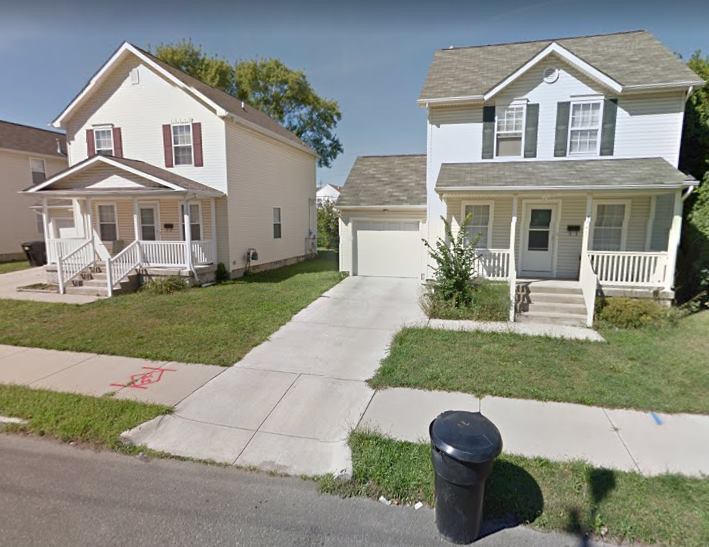
Alas, there are still many examples of blight side-by-side with new houses, such as Holcomb Avenue, a side street off Edgewood . . .


This is Eastlawn Street on Detroit's east side, in a block where only one house remains after disinvestment in the area. It looks like western Ukraine after Chernobyl. As fate would have it, an accident at a nuclear power plant in Michigan almost endangered Detroit a year before the riot: "We almost lost Detroit." But we did indeed lose it. Unlike Newark, which saw its population increase to 281,764 in 2010 after seven decades of decreases from an all-time peak of 442,337 in 1930, Detroit has seen its population dwindle to about 673,000, without so much as a negligible upward blip in between, from its all-time peak of 1,849,568 in 1950. In other words, Newark has retained about 64 percent of its all-time peak population; Detroit has lost about 64 percent of its all-time peak population.
The late Coleman Young, who blamed a lot of Detroit's problems on racism, explained the impact of the 1967 insurrection this way: "The riot put Detroit on the fast track to economic desolation, mugging the city and making off with incalculable value in jobs, earnings taxes, corporate taxes, retail dollars, sales taxes, mortgages, interest, property taxes, development dollars, investment dollars, tourism dollars, and plain damn money. The money was carried out in the pockets of the businesses and the white people who fled as fast as they could." Yes, all of that is true, and racism is a primary reason for Detroit's decline just as it was the reason for the decline of Newark, but, as I have already tried to make clear, that's not the only reason. As the primary center for manufacturing the cars that made that flight possible, Detroit was indeed the victim of its own success. And when the auto industry failed, Detroit failed with it.
"The city that spawned the auto age," James Howard Kunstler wrote, "is the place where everything that could go wrong with a city, did go wrong, in large part because of the car."
In many ways Detroit is the place where America died and went to hell. The racism and the economic dislocation caused by the aftermath of the riot and the de-industrialization of America led in part to the political divisions we deal with today. It was Detroit's northern suburbs in Macomb and Oakland counties that saw the rise of "Reagan Democrats" - white working-class registered Democrats that voted for Ronald Reagan for President in 1980 out of anger over the decline of manufacturing and resentment toward a welfare state they believed benefited only racial minorities. From there it was a logical step to Newt Gingrich, then to the Tea Party and, finally, to Donald J. Trump. Sad.
To be fair, Mike Duggan, Detroit's current mayor, has done a lot to bring his city back from the brink. But there's still a long, long way to go.
Monday, July 17, 2017
"All You Need Is Love" - Fifty Years
Fifty years ago today the Beatles released in the United States their single "All You Need Is Love," which perfectly captured the optimistic mood of the summer of 1967 - the Summer of Love. For those who missed it when I posted the promotional clip for the song as my Music Video Of the Week, here are my comments from that post, slightly reworded here.
"All You Need Is Love" had already been issued in Britain on July 7, 1967, and of course it had been premiered globally the month before on international television, on June 25, 1967, for the satellite TV special "Our World," shown on the BBC in Great Britain and on National Educational Television (a forerunner of the Public Broadcasting Service) in the United States. The Beatles officially represented Britain for the broadcast. (The United States aired a story about the U.S.-Soviet summit between President Johnson and Soviet premier Alexei Kosygin in Glassboro, New Jersey that had been held over the previous couple of days, once again demonstrating American cluelessness brought on by Cold War psychosis.)
The Beatles had been asked to present a song that would have a simple, direct message that people everywhere could understand. They waited until about ten days before the international broadcast before even writing "All You Need Is Love," which was mostly written by John Lennon, and they spent the intervening time recording a basic rhythm track for the song. It would be performed partially live, with backing tapes, and the result - take 58 - became the master for the single. (The live elements would be Paul McCartney's bass, George Harrison's middle-eight lead guitar solo, John's lead vocals, Ringo Starr's drums, and an orchestral backup.)
On the big night, the Beatles performed "All You Need Is Love" for four hundred million viewers around the world. The group worked in a sample of the French national anthem at the beginning and producer George Martin added in samples of "Greensleeves" and Glenn Miller's "In the Mood" at the end, along with an impromptu chorus of the Beatles' own "She Loves You," from 1963. That was a joke - the Beatles were a very different group in 1967 from the group they had been a mere four years earlier. The performance from EMI Studios at Abbey Road took on a party atmosphere, reviving the idea of a celebration from the February 10, 1967 orchestral overdub session for "A Day In the Life" (filmed for a documentary on the making of Sgt. Pepper's Lonely Hearts Club Band that was never completed because the BBC banned the song "A Day In the Life" for an assumed drug reference, which you already know about). And so Mick Jagger and Keith Richards of the Rolling Stones were invited, as were Eric Clapton, the Who's Keith Moon, Graham Nash and his then-wife Rose, George's then-wife Pattie, Paul's then-girlfriend Jane Asher and his brother Mike, among others. Also, some of the guests wearing sandwich signs with the song's title in four languages paraded throughout the room. It was that sort of broadcast.


The Beatles and their guests wore the colorful clothes of the psychedelic age and decorated the room with all sorts of colorful objects; balloons, flowers, and the like. Too bad the BBC transmitted the performance in black and white. Decades later, Apple Corps would colorize (or "colourise," as the Brits would put it) the clip of the performance based on color photos of the event; it was perhaps the only time colorization, originally used in the eighties on classic black and white movies, was used for a good purpose.
"All You Need Is Love" was the high-water mark of the Beatles' career; having just released Sgt. Pepper's Lonely Hearts Club Band, they were on top of the world, and now they had a new single that expressed the hopes and desires of the planet. Of course it was a number-one single all over the world, coming out on July 7, 1967 in Britain and being released ten days later, July 17, in the U.S. "With the Our World promotion," Beatles historian Mark Lewisohn wrote in 1988, "it could hardly have failed."
It wouldn't take long, though, for the hope that love would be all we needed to turn out to be more wishful thinking than reality. With U.S. troop levels still rising in Vietnam, the promise of peace and love seemed distant. Then, violence and hatred hit home in America; five days after "All You Need Is Love" was released in Britain, a race riot erupted in Newark, New Jersey, as noted earlier on this blog, and, a week after the song was released in America, Detroit experienced a race riot that surpassed the Newark riot in its viciousness. (More about that later.) The reverberations of such rage over injustice would be felt all over the world the following year - in Prague, in Paris and Chicago. John Lennon would later say, "I really thought that love would save us all."
It's still a great song. As Ringo Starr would later say, the answer was love. That's what the Beatles were all about.
Wednesday, July 12, 2017
The Newark Riot - Fifty Years Later
It was fifty years ago today that the seething resentment of black Americans toward the glacial pace of reversing racial injustice and urban black poverty exploded at its greatest scale up to that point. It could have happened in large cities such as New York, Chicago or Los Angeles, and it could have happened in any city in the South.
Instead, it happened in Newark, New Jersey.

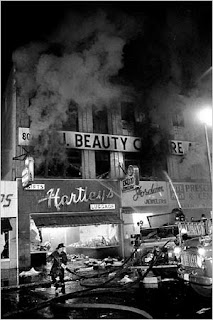 The riot, which originated in the Central Ward, spread to other parts of town and pitted the police and the rioters in a full-scale urban war. Even Broad Street (above), the city's main downtown thoroughfare, was not spared. New Jersey Governor Richard Hughes was forced to send in the state militia, and the tensions escalated. The heavy-handed reactions by the police and the militiamen made some people wonder why the rioters were being called the aggressors.


Newark in 1967 was a working-class city that was seeing its white population move to the Essex County and Morris County suburbs to the west for houses on larger lots and the new shopping centers sprouting up along the highways. Blacks had become the majority of the city's population, and even the few who could leave were denied newer housing in suburbia. (Black suburbanization took root instead in inner suburbs, such as East Orange, which was also being abandoned by whites, as well as in neighborhoods in nearby towns like Montclair.) Blacks still accounted for only 11 percent of the Newark police force, and they were denied the best jobs in the municipal government, still dominated by Irish and Italian politicians. Mayor Hugh Addonizio, who would be the last non-Hispanic white mayor of Newark, seemed utterly clueless to the social discord.
In July 1967, as young people in San Francisco were having love-ins, the situation in Newark finally blew up. Two Italian-American policemen, John DeSimone and Vito Portrelli, stopped and arrested a black taxi driver, John Weerd Smith, after he drove past their patrol car improperly on Fifteenth Avenue in the Central Ward, and they took him to the local precinct station. Residents of a public housing project (one of those high-rise brick-box projects that are a testament to how providing shelter for the poor is an afterthought in American housing policy) across the street from the precinct station saw them dragging an incapacitated Smith into the precinct. Though Smith was brought to a nearby hospital, rumors began that he had died in police custody. Angry residents confronted police at the station, and the trouble began almost immediately.


The presence of the militia, or the National Guard, made Newark look more like Saigon than an American city.
The fires and violence caused by the insurrection leveled whole neighborhoods. Numerous businesses were wiped out. Twenty-six people were dead and 727 were injured by the time when it was all over. And, lest anyone thought it was just a conflict between the powerful and the powerless, black retailers took the initiative to scrawl the words "SOUL BROTHER" on their front windows to deter black rioters from looting black businesses. The racial lines had indeed been drawn.
White Newarkers, then 46 percent of the city's population, staged their own revolt - by packing up their cars and accelerating the white flight to the suburbs. Among them were one Wilbur Christie and his wife Sondra, the parents of the current New Jersey governor, who moved to suburban Livingston.
The city went through a long period of decline, as the industries that supported it gradually faded away, leaving the Prudential insurance company, founded in Newark in 1875, still anchoring the downtown business district. Newark has been on the rebound lately. Broad Street hasn't looked as clean as it does now in years. There are new light-rail trains and a new streetcar line connecting the old Lackawanna railway station on Broad Street run by NJ Transit and the old Pennsylvania Station now serving NJ Transit trains, Amtrak intercity trains, and Port Authority Trans-Hudson (PATH) trains to New York. There's a burgeoning arts community, along with the New Jersey Performing Arts Center and an arena where the New Jersey Devils hockey team play. The building once occupied by Hahne's, a department store that has long since gone out of business, has been restored, with housing and retail (including a Whole Foods). And the population, which bottomed out at 273,546 people in 2000, has risen to 281,764 - above even 1990 levels. Many of those new residents, no doubt, moved to the new housing that replaced the slum on Fifteenth Avenue (below).

But Newark is still down in the dumps. Violent crime is an everyday occurrence. The school system leaves a good deal to be desired. A minor-league ball team failed, and its stadium is an empty shell. Vacant lots are visible both in the neighborhoods and in the downtown area. And when you walk in either direction on Market Street away from Broad Street, the scenery is pretty shabby . . . and the sight of the abandoned and once-grand Paramount Theater is heart-breaking. A seventy-old man who remembers the glitz and glitter of downtown Newark that he experienced as a ten-year-old boy, returning to the city after sixty years, wouldn't recognize Market Street today, least of all its intersection with Washington Street.

Note the absence of live people on the sidewalks.
The building on the right is the site of Bamberger's, once northern New Jersey's premier department store, which later branched out to the new malls in the suburbs. Macy's bought the Bamberger's chain, eventually changed the name of the stores to Macy's, and closed the original Newark store in 1992; the building is still waiting for a rehabilitation. I recently showed my friend Clarisel around downtown Newark, and when we got to the intersection of Market and Washington Streets, well . . . I was so embarrassed, it would have been rude for me to voice my true feelings. I'm not from Newark, but my uncle - my father's brother-in-law - is, and he grew up in the old Irish neighborhood in the North Ward, where the late Supreme Court Justice William J. Brennan, Jr. came from. My father went to St. Benedict's Preparatory School just a few blocks from downtown. My family remembers going to Bamberger's every Christmas, where they had snow villages and a slide along Santa Claus's chair not unlike the one in the movie A Christmas Story. I don't remember the Newark of old; I only hear stories about a place I will never know for as long as I live.
I don't blame the rioters for the decline of Newark. I blame America's asinine urban development policy that champions tract housing and highway shopping complexes over traditional cities, as well as the de-industrialization of America that sent all of the good jobs to China. I also blame an anti-urban, anti-poor, anti-non-white attitude among our leaders that allowed cities like Newark to deteriorate. Newark's slow pace of revival is proof people that, as in the case of racial equality, progress has been made but we still have a long way to go.
John Weerd Smith later declared that if he hadn't been arrested and mistreated by the police, something else would have inevitably happened to spark an insurrection.
The 1967 Newark riot was the worst American urban civil disturbance of the 1960s . . . until Detroit blew up less than two weeks later.
Friday, July 7, 2017
Music Video Of the Week - July 7, 2017
"All You Need Is Love" by the Beatles (Go to the link in the upper-right-hand corner.)
Subscribe to:
Posts (Atom)


 Posts
Posts

