Showing posts with label Ronald Reagan. Show all posts

Monday, March 20, 2023

March Surprise

In his 1991 book "October Surprise," former U.S. National Security Council member Gary Sick said he had reason to believe that the 1980 Reagan presidential campaign made overtures to Iran to prevent the Islamic revolutionary government from releasing the American hostages they had been holding since November 4, 1979 before Election Day - which, coincidentally, was one year to the day after the Americans at the U.S. Embassy in Tehran were seized - so as to continue to hurt President Jimmy Carter's chances for re-election.  Sick, however, didn't have a smoking gun to prove his thesis unreservedly, and he admitted as much, so the idea of a plot against President Carter was mostly hearsay.    

Until now.

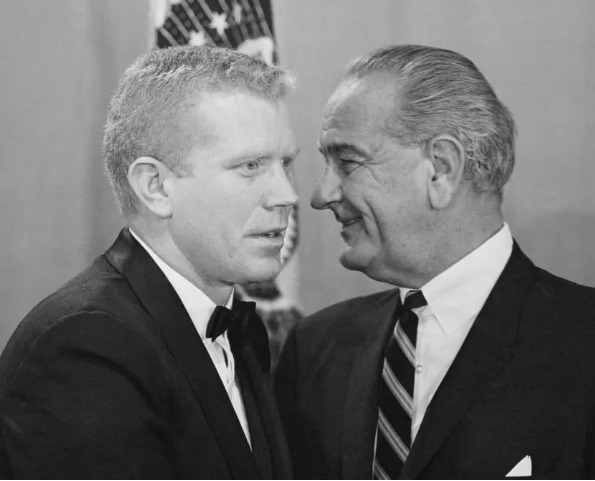
Ben Barnes (shown above, in his younger days, with President Lyndon Johnson) was a political wunderkind who became Speaker of the Texas House of Representatives in 1965, when he was only 26 years old.  Barnes, who later became Lieutenant Governor of Texas, received counsel from then-Governor John Connally while he was Speaker; both were Democrats but later became Republicans.  Connally, who had spent a million dollars on his campaign for the 1980 presidential nomination only to receive one delegate, hoped to get an appointment as Secretary of State or Secretary of Defense in a Reagan administration.
In an interview with the New York Times, Barnes says he accompanied Connally on a trip to the Middle East, where Connally told Arab leaders, “Look, Ronald Reagan's going to be elected President and you need to get the word to Iran that they’re going to make a better deal with Reagan than they are Carter. It would be very smart for you to pass the word to the Iranians to wait until after this general election is over."

Barnes also says that he and Connally also met with former Securities and Exchange Commission director William Casey, who was managing Reagan's 1980 general election campaign, to report the trip.  While Connally did not get either Cabinet position he was hoping for (and declined the post of Secretary of Energy, which went to - I am not making this up - a dentist), Casey became Reagan's CIA director; he eventually got involved in another scandal involving Iran - the Iran-contra affair - by a[proving illegal diversion of funds from Iran arms sales the Nicaraguan contras, being implicated by General Richard Secord in the Iran-contra hearings less then 24 hours before Casey died.
There are three conclusions to this story:
  • Reagan's outreach to Iran in his second term was tainted not by its secrecy but by his campaign's underhanded rigging of the 1980 election, so what I said in January 2020 no longer applies. 
  • This is as equally horrible as the story about Nixon rigging the 1968 election by telling the South Vietnamese not seek a deal to end the war in Vietnam with the Johnson administration with the promise of a better deal from a Nixon administration, because of the 42 years and counting of the far-right hold on the country's affairs.
  • We should be glad John Connally was never elected President.

Thursday, January 9, 2020

I Apologize To Ronald Reagan

Yes.  I'm apologizing to the memory of Ronald Reagan.

Not for his economic policies, which still remain in force to this day, or for his Central America policy, which did more harm than good, and certainly not for Grenada, but for his Iran strategy.
What?  Hear me out.  In attempting to deal with a troublesome theocratic regime in control of Iran, Ronald Reagan sought to pursue quiet diplomacy with the mullahs and clerics who sustained the Supreme Leader, Ayatollah Ruhollah Khomeini.  Iranian proxies were holding hostages in Lebanon, and Reagan was desperate to get them out without having to pull something as foolhardy as Desert One (and the 1983 Beirut bombing of a Marine Corps barracks probably scared the Shinola out of him when it came to using force in the Middle East).  So he approved a secret strategy to trade low-grade, low-priority military hardware for the release of American hostages in Lebanon, ultimately getting three of them released before the operation was exposed in November 1986.  Attitudes toward Iran were still bitter with the hostage crisis of 1979-81 still fresh in people's minds in 1986 (including, I suspect, the mind of a 40-year-old real estate developer named Donald Trump), though, and the operation did not go over very well with the American people.  After having vowed never to deal with terrorists, Reagan seemed to be doing just that.  How could he do such a thing?
To understand why he did so, you have to look back at what was happening in the 1980s.  Iran was slowly gaining influence in the Middle East and was in a protracted war with Iraq, then under control of Saddam Hussein.  In the interest of playing Iran as a counterweight to Iraq, reducing Soviet influence in the region, and trying to quell the civil war in Lebanon, Reagan sought to deal with the Iranians in secret to improve relations with the Khomeini government.  Robert McFarlane, President Reagan's third national security adviser, summed up the reasoning for a rapprochement with Iran in the following memo from June 1985: "Dynamic political evolution is taking place inside Iran. Instability caused by the pressures of the Iraq-Iran War, economic deterioration and regime in-fighting create the potential for major changes inside Iran. The Soviet Union is better positioned than the U.S. to exploit and benefit from any power struggle that results in changes from the Iranian regime . . .. The U.S. should encourage Western allies and friends to help Iran meet its import requirements so as to reduce the attractiveness of Soviet assistance . . .. This includes provision of selected military equipment."
So, Reagan was trying to make nice with the Iranians rather than make war on them.  And he did so over the objections of Defense Secretary Caspar Weinberger and Secretary of State George Shultz.  There was just one problem, something Weinberger and Shultz sensed - the Iranians were never really interested in any sort of rapprochement.  Reagan was sincerely trying for a major foreign policy breakthrough not unlike Nixon going to China, but Khomeini, unlike Mao, was never going to meet with the enemy.  He played Reagan for a fool.  That's not Reagan's fault.  Khomeini could have reciprocated for the good of stability in the Middle East, but he preferred to humiliate the U.S. instead. But, given Trump's current saber rattling, Reagan's explanation of his Iran operation in a televised address to the nation on November 13, 1986, sounds quite reasonable: "My purpose was . . . to send a signal that the United States was prepared to replace the animosity between [the U.S. and Iran] with a new relationship . . .. At the same time we undertook this initiative, we made clear that Iran must oppose all forms of international terrorism as a condition of progress in our relationship. The most significant step which Iran could take, we indicated, would be to use its influence in Lebanon to secure the release of all hostages held there."  I thought at the time that we were headed for a war.  Silly me.  If Reagan had tried to do what Trump is doing now, I would have been more justified in that fear. 
But what about the scandal?  The scandal involved the proceeds of the money received from the arms sales going to help the Nicaraguan rebels - the contras - which was illegal.  We remember the Iran-contra affair as a scandal, but it was the contra part, not the Iran part, that was the scandal.  And that was orchestrated by John Poindexter and Oliver North without Reagan's knowledge.
Reagan survived the scandal, and looking back on his efforts to set things right with the Iranians, it must have seemed like a good idea at the time - certainly better than starting World War III.  His strategy had this much in common with Desert One, though - it would have been a positive game-changer had it worked. :-(   

Tuesday, January 8, 2019

The Forty-Year Itch

I've concluded that the years between 1980 and 2020 will be looked upon by future historians - assuming that climate change doesn't wipe out the human race first - as the period in which America lost its mind.  It will be remembered as the period in which social, political, and cultural standards fell through the floor, a time when abolishing taxes on the rich and abolishing abortion services for women were considered sound government policy, a time when when privatizing public services and making private lives public domain was considered normal, a time when speaking aggressively into microphone to a computerized beat was accepted as music, a time when movies with commuter-generated special effects were heralded as great cinema, a time when advances in communication  resulted in a loss of the art of communicating, and a time when being famous for existing counted more than being famous for doing.  As Kurt Andersen recently wrote, there's always been a degree of insanity binding These States together, but the most recent four decades have been crazier than the two centuries that came before.
Attentive readers will note that this period is framed by Ronald Reagan's election to the Presidency and Donald Trump's planned bid for re-election to that office.  That, of course, is assuming he isn't forced out of office first.  But the Ronald and the Donald make perfect bookends to the most recent four decades - two entertainers fronting the Republican right wing and getting elected President with some vague promise of restoring American greatness, only to preside over a further diminishing of this land we call home.  In between, we've had as President two guys named George Bush who sought to preserve the legacy of Ronald Reagan and two young, engaging moderate Democrats who got elected because their charisma reminded people of Reagan.  And Reagan's supply-side economics made Trump possible.  Both men symbolize 1980s greed, and even today it still feels like we're still living in the 1980s.
Now, there were times before when I thought that this era of foolishness and devolution were coming to an end.  I thought so when Bill Clinton was elected President, when 9/11 shook everyone out of complacency, when the Republicans lost control of Congress in 2006 and paved the way for Barack Obama's election to the Presidency in 2008, and when Obama was elected in the aftermath of the worst economic downturn in eighty years.  Each time, I was wrong.  And then it hit me: This era was kicked off by an insubstantial, opportunistic incompetent showman becoming our leader.  For this era to end, we needed another an insubstantial, opportunistic incompetent showman to lead us.  But not just any old insubstantial, opportunistic incompetent showman - we needed someone who made Ronald Reagan look like George Washington, someone who disrespected the norms and ideas of what leadership should be, someone who went beyond misunderstanding the facts, as Reagan did, but who instead would offer lies in the guise of "alternative facts."  We needed someone who would wake Americans up more than any terrorist attack, stock market crash, or cynical war policy ever could.  We needed Trump to show us who we are . . . and, quite frankly, what we've become.  And his current push to declare a national emergency so he can build a border wall that the majority of Americans do not want may be the tipping point.  The antidote to the rattlesnake's venom is the venom itself.
But that does not mean we're going to automatically turn the page in 2020 and start a new, more civilized, more enlightened era.  Now that Trump has us aware, we need to turn that awareness into action.  The 2018 midterms may have been an excellent start, but they were just a start. We need to work hard and push harder to get Trump out of the White House.  But even if we elect a new President with intelligence, dignity, honesty, and integrity, that won't mean diddly-squat if we all go home and let that person run the country like we did in 2009.  Because even if we have a Democratic President and a Democratic Congress in 2021, we could still have a Democratic Party beholden to corporate interests and not the people.  If we want to end stupidity and barbarism and all that stuff, we gotta hold a Democratic Congress accountable and make them educate our children better, come up with sustainable energy and transportation systems, end gun violence, help local economies, and provide all of the other nice things that make a country worth living in.  And if hate has no home here, we gotta make sure that anyone who supports a hateful person like Donald John Trump has no home in the body politic. 
And if a Democrat is somehow elected President in 2020, then we gotta hold his or her feet to the fire.  Part of the reason Franklin Roosevelt did so much to save America from the aftereffects of a similarly foolish era in our history (the Roaring Twenties) is because Americans made him do it - he wanted to give us Social Security and public works, but he couldn't have done it without the people making him and Congress do it.  Either we do this with the 46th President and the 117th (and 118th) Congress or we end our decline not with a renaissance but with a fall, like what happened with Odoacer's conquest of Rome in A.D. 476, the Norman conquest of England at the Battle of Hastings in 1066, or the Turkish capture of Constantinople in 1453.  
This is the fifth or sixth time I have believed that this era of decline was coming to an end.  This time, let's make sure it is.  It began with a smarmy showman, so let's make sure it end with the smarmy showman we have now.

Wednesday, April 25, 2018

Locked and Loaded

North Korean leader Kim Jong Un says his country will no longer test nuclear weapons.

Donald Trump sees this as positive step in advance of his planned summit with Kim later this spring.
Uh, Donald?  The reason Kim isn't testing nuclear weapons anymore is because he doesn't need to test them anymore.  The experimental phase is is over - North Korea is now a nuclear power!  Kim wanted those weapons because he believes that peace can only be achieved from a position of strength.
And where did he get that idea from?  He got it from us!
Specifically, this guy.
Or maybe you don't remember the American arms buildup of the early 1980s.
Right, now that Internet neutrality has officially bitten the dust, I don't expect this post to get very far . . .

Wednesday, March 28, 2018

Make "Make America Great Again" Great Again

"Make America great again?"
Donald Trump's 2016 presidential campaign slogan has long carried a lot of negative connotations for his political opponents, many hearing in it a hostility toward people of color and an aversion to the idea of white men having to share power with anyone else.  When Trump said, "Make America great again," his detractors heard "Make America white again," or "Make America illiberal again."  So, of course, did the Trump base.  And in fact, that's what Trump was pretty much suggesting -  going back to the 1950s and putting black people back in low-paying service jobs and preventing them from voting, keeping Mexicans from emigrating into this country, or putting women back in the kitchen, all of that stuff.  
The only thing is that, putting aside that coded message for a moment, it was easy for anyone in 2016 to argue that America was no longer great. Because a country that lags behind the rest of the developed world in health care delivery, public transportation, math and science education, and children's welfare while ranking first in gun deaths, low voter turnout, billionaires, and pregnancy-caused deaths is not great.  It is in fact the opposite of great.  A country that used to have good-paying jobs you could build a life on but has since outsourced them to other countries and has not replaced them with the sort of jobs you need to sustain the middle class is also the opposite of great.    
When people who voted for Trump heard him say he wanted to make America great again - a phrase, by the way, that he stole from Ronald Reagan - not all of them heard the exclusionary, discriminatory message he was sending.  Many of them heard the idea of bringing America back to a time when its manufacturing base was second to none, its educational system was among the finest in the world, and its public works were public and worked.  I've seen memes on Facebook suggest the same thing, asking if we remember how, in the 1950s, people were more polite, only one parent had to work, and children could play by themselves in the park or in the street without their parents having to worry about their children's pictures ending up on milk cartons.  And besides, back then milk was sold in bottles - and delivered by truck.  If people want to go back to the 1950s, it's the best of the 1950s they want to return to - a respected war hero as President, movies with fewer special effects and more character-driven stories, and pop stars who could actually sing and play music - that is, a culture far less coarsened than it is now.  Many of them do not want to go back to the dark side of the fifties - right-wing demagoguery, war in Korea, a mendacious political hack as Vice President, and black people being denied their civil rights.
Ironically, we either have or are about to have all of that.  Trump has restored the worst elements of the fifties without bringing back good-paying jobs or the sense of decency associated with the Eisenhower years.  Even more ironically, his 2020 campaign slogan is expected to be "Keep America Great" - "because I already made America great again!"     
The Democratic response to Trump's 2016 slogan was pathetic.  Hillary Clinton insisted that America "never stopped being great," and even Martin O'Malley insisted that "America already is great" -  the rebuttal, I suppose, you would expect from the incumbent party in control of the Presidency, as the Democrats were at the time.  But these rebuttals ignored all of the problems Barack Obama had not been able to solve.  (I know, I know, he had to deal with Republican majorities in Congress, but that excuse is only valid up to a point, as Obama was never really the liberal Republicans made him out to be.)  Many people thought that Trump was an honest broker for telling the truth about America - namely, that it was in decline.  But how many people who voted for Trump ever suspect - despite ample evidence during the 2016 campaign - that Trump would accelerate America's decline?  And do Trump loyalists, those die-hard base supporters who did vote for him knowing what he really meant by "Make America great again" - restoring white patriarchy - and continue to support him, really think America is great again when they still can't get a good-paying job or send their kids to college?
Back in the 1980s, when Ronald Reagan was laying the groundwork for America to become a right-wing, supply-side utopia and his successor George H.W. Bush was locking in Reagan's changes, it was the Democrats who said that America was in decline, and even though none of them ever said they wanted to make America great again, in those exact words, they did say they wanted to return America to being a place that was on the rise.  Walter Mondale promised an "American Renaissance" in jobs and education when he accepted the 1984 Democratic presidential nomination.  Gary Hart wanted to redefine Democratic liberalism and pursue new policies that would prepare America for a new post-industrial economy.  Michael Dukakis espoused policies that would provide the same opportunities for Americans that his immigrant parents had, and his 1988 campaign slogan was "The best of America is yet to come."  (In other words, make America better.)  And I definitely remember Richard Gephardt - who was talking about unfair trade practices long before Trump - say in in 1989 that America was "in decline."  And even before Reagan became President, Democrats were talking about renewing America's exalted position; Jimmy Carter's 1979 "crisis of confidence" speech was in fact a call for Americans to rediscover civic virtue and return the nation to greatness.  This was all before Bill Clinton came along and redefined the Democratic Party as a party happy to get along and go along with the corporate neoliberal forces that make America anything but great.
Trump clearly has no interest in truly restoring America's greatness.  The only thing he really wants to aggrandize is himself.  The message of restoring America's greatness - a greatness that disappeared sometime between the last moon landing and the first oil crisis - was, Reagan notwithstanding, a Democratic message untainted by racial and patriarchal overtones before Trump stole it for his own nefarious schemes.  This is yet another message that Democrats have to steal back.
Which means they can no longer pretend that America never stopped being great.  Those who do pretend so are themselves great . . . a great disappointment.     

Sunday, April 30, 2017

Fifth Generation Reaganomics

First there was President Ronald Reagan's 1981 supply-side economic program . . . cut domestic spending, cut taxes on the rich, let them invest money in factories, and more people will join the workforce and contribute to the tax base.  In other words, tax work instead of wealth.  Reagan economics - called, henceforth, "Reaganomics" - worked, at least in the short term, but not the way Reagan, Arthur Laffer, Jude Wanninski, and other economic conservatives envisioned.  The rich people invested their tax cuts in themselves, and most of the jobs created in Reagan's eight years - which lowered the employment rate from 7.4 percent in February 1981 to 5.4 percent in January 1989, making Reagan the only Republican President since World War II to leave office with the unemployment rate lower than what it was when he entered office - were low-wage jobs that no one could reasonably expect to make a living from.
The tax cuts blew up the deficit and caused a recession, forcing tax increases in 1990 under the senior George Bush and another tax increase under Bill Clinton in 1993.  With the passage of a budget that year that increased domestic spending, then-House Speaker Tom Foley, a Democrat from Washington State, said we had come to the end of Ronald Reagan.
Ironically, he lost his House seat in the Gingrich revolution of 1994 that gave us a Republican Congress and Reaganomics Mark Two.  Only President Clinton's firm stand on deep spending cuts, plus a 1995 government shutdown that neutralized Speaker Newt Gingrich, prevented another deficit; in fact, with many tax hikes still in place and with measured spending cuts to boot, a budget surplus was generated.  Not to mention decent jobs.   
Then came the third iteration of Reaganomics with George Walker Bush and his 2001 and 2003 tax cuts, blowing the surplus and putting the country deeper in debt and leading to the loss of good jobs that, quite frankly were lost for good.  And military spending went way up thanks to not one but two wars in the Middle East.  And then came the 2008 financial crisis.
Barack Obama then came into office with a Democratic Congress in 2009, with many Americans thinking we'd seen the last of Reaganomics. Fourth generation!  The Tea Party came into power in Washington in 2011 and brought it back.  More jobs lost, more tax breaks for wealthy people.
Now Donald Trump is the White House with a Republican Congress, and his tax reform proposal is essentially Reaganomics Mark Five - Reaganomics on steroids.  I won't go into the details, because, quite frankly, neither has Trump.  The proposal - which would pretty much give corporations a huge tax break - only takes up one page of a ream of paper. 
We've seen this movie before.  And not only does it keep getting worse, the celluloid is wearing very thin.

Friday, May 13, 2011

Newt As Ronnie's Heir

Newt Gingrich is running for President of the United States.
Many people have long been sickened by the fact that a divorced and remarried man who talks up a game of family values, a man known for speaking optimistically of America one minute and taking cheap shots against political opponents the next, and making incendiary comments based on gross distortions of history, would seek America's highest office.
But Ronald Reagan was elected President anyway.
Surprise! No, I wasn't talking about Gingrich just now, but what has been said about him can easily be applied to our fortieth President. We all know that Reagan, a family values apostle who once complained that we can't talk to God in our schools anymore, divorced actress Jane Wyman. Some of us many even know that Nancy Reagan was already several weeks pregnant with her daughter Patti when she and Ronnie got married. But does anyone remember Reagan's nasty disparaging of the counterculture movement of the late 1960s and early 1970s when he was governor of California? He once spoke of seeing a hippie who "spoke like Tarzan, had long hair like Jane, and smelled like Cheetah." Seeing a group of demonstrators holding signs saying "Make Love, Not War," he turned to someone and said, "Those kids don't look capable of doing either."
Newt Gingrich likes to throw the word "fascist" around a lot. Well, it was the Reagan administration that once said that the New Deal and its proponents "espoused fascism." Newt likes to call opponents nasty names. Anyone remember what Reagan said about Michael Dukakis, when it looked like the son of Greek immigrants would succeed him in the White House, concerning a story that Dukakis had once seen a psychiatrist? "Look, I'm not going to pick on an invalid."
Witty. Witty.
So, there's actually a precedent for cynical nastiness - or nasty cynicism - in the Oval Office, even if Chris Matthews doesn't want to admit it.
And so, the notion of "President Gingrich" doesn't seem so preposterous.

Sunday, February 6, 2011

Ronald Reagan's Greatest Hits

Today the nation marks the one hundredth anniversary of the birth of Ronald Reagan, an undertalented, slick movie actor who played the President of the United States from 1981 to 1989. Of course, a lot of people have sound reasons for not wanting to mark the birth anniversary of a man whose policies they saw as inhumane, selfish, intellectually bankrupt, and politically dishonest. Well, I already touched on the specifics of that on this blog in June 2004 (a link to that post is here), less than two weeks after his death. (I came to bury Reagan, not praise him.) Today, I call attention not to his deeds, but his words. Because when Reagan spoke, he proved to be a very gifted comedian, even though he was unintentionally funny. Here, on the day Reagan would have referred to as the sixty-first anniversary of his thirty-ninth birthday, are some laughable lines from the man conservatives have declared the greatest President of our lifetimes:
At the start of his 1980 presidential campaign, Reagan charged the Environmental Protection Agency of suppressing information with this bombshell: "The American Petroleum Institute filed suit against the EPA [and] charged that the agency was suppressing a scientific study for fear it might be misinterpreted . . .. The suppressed study reveals that 80 percent of air pollution comes not from chimneys and auto exhaust pipes, but from plants and trees." (No scientific data supports this assertion.)
As President, Ronald Reagan declared in 1981, "Trees cause more pollution than automobiles do."
Both of these quotes were the result of Reagan's confusion of nitrogen oxide, a harmful carbon, with nitrous oxide, a natural by-product of trees. And it probably led him to say this in October 1980: "Growing and decaying vegetation in this land are responsible for 93 percent of the oxides of nitrogen." In fact, according to Dr. Michael Oppenheimer of the Environmental Defense Fund, industrial sources are responsible for anywhere between 65 and 90 percent of the oxides of nitrogen in the U.S.
In a 1983 speech delivered in Oregon, "There is today in the United States as much forest as there was when Washington was at Valley Forge." Actually, only 30 percent of the forest that existed in the present-day United States in 1778 was still preserved in 1983.
And passenger rail advocates will love this May 1980 argument against subsidizing Amtrak and other forms of passenger rail transit: "Trains are not any more energy-efficient than the average automobile, with both getting about 48 passenger miles to the gallon." However, the U.S. Department of Transportation calculated that a train of fourteen passenger cars traveling at 80 miles per hour gets 400 passenger miles to the gallon. A 1980-model automobile carrying an average of 2.2 people got 42.6 passenger miles to the gallon.
But wait! There's more! How about some of these doozies?
Asked what he learned on a state trip to South America in 1982, President Reagan replied, "You'd be surprised. They're all individual countries." A White House aide had to go to the press to insist that Reagan didn't mean to suggest that he was surprised by this.
During his 1976 presidential campaign, Reagan declared, "Fascism was really the basis for the New Deal."
In 1985, President Reagan called the mercenaries in Nicaragua trying to overthrow the Marxist Sandinista government there "the moral equal of our Founding Fathers."
"I've been told," President Reagan said that same year, "that in the Russian language there isn't even a word for freedom." The Russian word for freedom is svoboda.
President Reagan once quoted Oliver Wendell Holmes, Jr. as saying, "Keep the government poor and remain free." The late Supreme Court justice never said that, though he did once say that taxation was necessary for a civilized society.
President Reagan defended his support for the apartheid government in South Africa in 1981 by saying, "Can we abandon this country that has stood beside us in every war we've ever fought?" Although South Africa, which became an independent country in 1910, fought in both World Wars on the side of the U.S. and Great Britain, the National Party, which developed the apartheid system after coming to power in 1948, had opposed South African participation in both wars. Many National Party members harbored pro-Nazi sympathies in the 1930s.
In 1983, President Reagan spoke to reporters about how "the ten commandments of Nikolai Lenin [are] the guiding principles of communism," among them "that promises are like pie crust, made to be broken." Although scholars pointed out that Lenin's first name was Vladimir, Lenin is sometimes identified as "Nikolai" Lenin, so Reagan can't be faulted for that. However, those same scholars declared that the ten commandments of Lenin that Reagan spoke of do not exist.
In 1985, President Reagan declared that few living Germans remembered World War II, "and certainly none who were adults and participating in any way." A few weeks later, he laid a wreath at Bitburg, a German military cemetery containing the graves of Nazi and American soldiers. Oops! Wait a minute! No Americans are buried there.
And how about this?
Upon declaring his candidacy for the 1980 Republican presidential nomination in 1979, the 68-year-old Reagan told Tom Brokaw that he was "younger than any head of state I would have to deal with except Margaret Thatcher." Not only were several world leaders of the time younger than Reagan, but as prime minister of Great Britain, Margaret Thatcher was the British head of government. (Queen Elizabeth II is the British head of state.)
President Reagan once insisted he had firsthand knowledge of the "bad things" that happened in World War II because, as he explained it, "I was in uniform for four years myself." That was true, but what the former actor didn't mention was that he was in a non-combat unit based in Los Angeles that produced training films.
On the possibility that 1988 Democratic presidential nominee Michael Dukakis had seen a psychiatrist for depression: "Look, I'm not going to pick on an invalid."
Defending his lapsed church attendance (an issue because of his alliances with the Christian right) in a presidential debate with Walter Mondale in October 1984, he talked about how he had started going to church as "here in Washington" as President before logistics forced him to stop. The debate was in Louisville. And if Reagan couldn't attend church due to security concerns, he could have held private services in the White House, as previous Presidents had done. He did not.
In that same debate, President Reagan referred to military uniforms as "wardrobe," as if they were costumes.
President Reagan insisted in a "60 Minutes" interview broadcast on January 15, 1989, just before he left office (and on Martin Luther King, Jr.'s birthday) that black civil rights leaders had done very well for themselves "keeping alive" the idea that blacks were "still the victims of racial prejudice." Jesse Jackson was not amused.
And how about this?
During a White House meeting with Arab leaders in October 1982, President Reagan turned to the Lebanese foreign minister. "You know," he said, "your nose looks just like Danny Thomas's." The Arabs were not re-assured.
And advocates for the homeless were hardly re-assured by this Reagan statement from January 1984: "You can't help those who simply will not be helped. One problem that we've had, even in the best of times, is people who are sleeping on the grates, the homeless who are homeless, you might say, by choice."
I could go on. In fact, I could be here for a whole week.
But while you ponder these pearls of record, ponder also that this man was this vast, diverse, powerful country's leader for eight freakin' years.
Ladies and gentlemen, the fortieth President of the United States!


(Speaking at a White House News Photographers Association dinner in May 1983, President Reagan suddenly stuck his thumbs in his ears and wiggled his fingers. Explained the President, "I've been waiting years to do this." :-O )
Monday, August 3, 2009

Changing Course?

Barack Obama has an ambitious agenda in reforming the health care system, instituting a comprehensive energy policy, and giving more people an even break - and possibly changing the culture and the direction of the country in the process. If he succeeds, it's because he took advantage of a time in the country when such fundamental change was possible to bring about. But it will also be because he's a better student of history than most people give him credit for.
When Ronald Reagan announced his candidacy for the 1980 Republican presidential nomination thirty years ago, Americans had come to take many social programs and government regulations for granted at a time when the economy was stagnant and enemies like the Iranians were embarrassing us by kidnapping our embassy staff. Reagan's policy proposals - cutting taxes for the rich to generate wealth and private investment, cutting social programs to instill moral character among their recipients, deregulating industry, less government involvement in everything except military contracting, more of just that to win the Cold War - were considered reckless, but President Carter failed to provide much in the way of alternative answers to the problems besetting America. Carter had actually hoped Reagan would be the Republican nominee, because a retired B-movie actor was the one Republican he thought he could defeat, but the desire for change was too great. Reagan won a landslide in what was supposed to be a close election.
Reagan then did everything he said he was going to do, except balance the budget, which he blamed on a Democratic Congress for ignoring his budget proposals (though the fact that he never submitted a balanced budget in the first place, due to all that military spending, never factored into his analysis). He'd taken advantage of a desperate time in American history in a bid to alter the country's course. When Reagan prepared to step down after two terms, Democrats were pleased that the old rogue charmer was on his way out and that the GOP had no inspiring candidates to pick up the Reagan mantle. They expected an easy victory in 1988 against Vice President George Bush, even with the competent but boring Massachusetts governor Michael Dukakis as their standard bearer. After all, Reagan was personally popular but his policies were too controversial to continue; surely America was ready to go back to the agenda in place in 1980.
What took Democrats like Obama twenty years to understand, though, from 1988 to 2008, was just how much Reagan had changed the trajectory of the country. His pro-business tax policy and deregulation practices unleashed an amalgamation of wealth among the upper classes and created a new economy based on investments and entrepreneurialism and less so on manufacturing and production. Wall Street became more important than Main Street. Social programs remained scaled back, while others were eliminated altogether. The changes, however flawed, were so fundamental that the culture followed suit. Christian evangelism, espousing personal responsibility, enjoyed a revival at a time of domestic policy shifts away from social welfare systems. MTV and yuppie culture were as jive as Reagan's simplistic sociopolitical homilies. People worked more for less, straining community bonds and families. American attitudes shifted to a more self-centered, Darwinistic world view - ironically, at a time when Darwinistic theories about evolution were challenged by a resurgent religious streak. Campaigning for office as a Democrat as if these changes were not fundamental and entrenched was no way to fight these changes.
The Democratic Party mostly failed to get that, which is how they managed to lose elections to guys named Bush. Unable to accept the idea that the country had been changed fundamentally, they tried to campaign and govern as if the old rules still applied and new rules didn't have to be challenged. Bill Clinton - the only Democratic President between 1981 and 2009 - certainly didn't get that when he tried to reform health care in his first term and enabled the Republicans to gain control of both houses of Congress, tabling the issue indefinitely. But Clinton (who won the Presidency in 1992 only because the older Bush was dealing with an recession mild enough to leave supply-side economics in place but severe enough to doom his chances for a second term) was never much of a liberal anyway. Though Clinton campaigned on the issue of putting people first, he normally put business first, deregulating the communications industry and appointing Wall Street executives to key Treasury posts. His Presidency was a success because it acknowledged the new order of things, but as a President who hoped to change things, he was a flop. His place in history is as the President between George Bush the Elder and George Bush the Younger.
Barack Obama shouldn't have been surprised by the backlash he got from other Democrats when he said that Reagan changed the trajectory of America, and he wasn't. Their reaction, though, suggested how clueless they were about how supply-side economics had been ingrained. They couldn't see how labor, civil rights groups, environmentalists, and public institutions like schools and transit systems were in 2008 in losing positions far more so than they had been in back in 1980. My grandmother got a letter from her labor union in 1980 urging her to vote against Ronald Reagan and explaining how he would return us to a pre-New Deal America. "You know what life was like before [Franklin] Roosevelt," the letter began.
After thirty years of Reagan and Reaganism, so do I. President Obama gets it. Hopefully, many Democrats in Congress do, too.