Showing posts with label Jimmy Carter. Show all posts

Tuesday, October 1, 2024

America's First Centenarian Ex-President

Happy birthday, Jimmy Carter!

James Earl Carter, Jr., the 39th President of the United States, is one hundred years old today.  He was already the longest-lived President in American history, so this birthday celebration is a milestone on steroids.
His Presidency was a single term, so he only spent one twenty-fifth of his life as the most powerful person in the world.   And his term in office did yield some unfavorable outcomes - airline deregulation, the Iran hostage crisis and the subsequent failed rescue mission, and the hamfisted and wrongheaded Moscow Olympics boycott.  Also, he was the last President in an era of Democratic politics that had begun in 1933 with Franklin Roosevelt and the New Deal and yielded Democratic victories in eight out of twelve presidential elections and control of 22 out of 24 Congresses - an era that ended with Ronald Reagan's victory over Carter in the presidential election of 1980.
But I come to praise President Carter, not bury him.  He managed to leave a solid legacy for a one-term President who had never served in Washington before, such as a sane energy policy that emphasised conservation and alternative fuels, he kept the nation out of war, and he achieved peace between Israel and Egypt.  Also, when things got tough - specifically in the horrible year of 1979, when gas prices hit a dollar a gallon for the first time (making gasoline more expensive than it is now, when adjusted for inflation), when we had prices rising faster than today, when Iranian militants seized the U.S. Embassy, and when we almost lost Philadelphia to nuclear error at Three Mile Island - President Carter didn't try to sugarcoat anything.  He told us the truth.  Things were bad, they'd get worse in the short term (as anyone who remembers 1980 would attest), and we had to gird our loins, grit our teeth, and bear it.
The election of 1980 proved that Americans don't like to be told the truth.  But Jimmy Carter went on to be the greatest former President since Republican Herbert Hoover (who, coincidentally, was the last President of a political era for his party), serving humanitarian causes such as building houses for the poor, getting fresh water available for Third World countries, and monitoring elections in various nations.  Now that he's a hundred, he can take it easy and look back on his long life with pride.'
Again, happy birthday, Jimmy Carter. 😊

Thursday, October 12, 2023

Olympian Power

The most astonishing thing about presidential powers in the age of Trump (sorry, Joe!) is how Trump himself exercised them to enrich himself and try to take full control of the mechanism of government.  Trump, of course, is the extreme example of the abuse of power,  and I don't want to compare any of his recent predecessors' behavior to the egregiousness of Trump's.  But it should be remembered that, in recent years, Presidents of the United States have always exercised power in a belligerent, authoritarian way, from Harry Truman finding a way to go to war against North Korea without Congress declaring war on what was essentially a government we did not recognize as legitimate (it was a "police action") to John F. Kennedy extending the trade embargo against Cuba by executive order to Richard Nixon refusing to spend money earmarked by Congress.  But even Jimmy Carter acted belligerently in enforcing the ill-considered boycott of the Moscow Olympics to protest the Soviet invasion of Afghanistan.
This is a subject I have discussed before on this blog, but it's worth revisiting now. 
The U.S.S.R. invaded Afghanistan in the last week of December 1979, which the United States viewed as a major crisis despite the fact that the Soviets were essentially intervening in Afghan affairs to swap out one Communist leader for another one.  Two months after Hafizullah Amin, a co-founder of Afghanistan's Communist government, deposed and executed President Noor Taraki, Amin himself was taken out by the Soviets in an effort by the Kremlin to place a government in Kabul under Babrak Karmal that would be more friendly to Moscow.  Coming as it did seven months before the start of the 1980 Moscow Olympics, President Jimmy Carter, who apparently thought that a Soviet-backed Afghan Communist leader like Karmal was a greater threat to peace than a renegade Afghan Communist leader like Amin, called for a boycott of the Summer Olympics.
When I originally wrote about this back in 2004, I more or less said that Carter was able to get the United States Olympic Committee (USOC) to support the boycott even as British Prime Minister Margaret Thatcher failed to get the British Olympic Association to do the same.  In fact, as I noted then, apart from Canada and West Germany, no allies supported President Carter's Olympic boycott. 
But I also said that the United States Olympic Committee ultimately agreed to support the boycott because Carter was "acting like the national governess, expecting the USOC to fall in line.. . .. If we Americans weren't such sheep, we would have boycotted the boycott . . .. But no, our Olympic committee voted to blindly support the President."  
But, as Kenny Moore reported in Sports Illustrated in April 1980, it didn't quite play out like that.
The USOC had in fact opposed making their athletes stay home, and the defiance of their British counterparts to Thatcher encouraged them to think they they could stand up to Carter.  But then the White House lowered the boom on the USOC, as they invited sports officials to the State Department for, as Moore reported, "strongly worded briefings which not only presented the Administration case that a boycott was a crucial element in a coordinated U.S. response to a dangerous situation in Afghanistan, but also made it clear that extraordinary measures would be taken to see to it that the USOC had no choice but to comply."   Moore also reported that The Justice Department told the USOC that the President could legally bar athletes from participating in the Games, and Carter vowed that he would in fact take such action if necessary.  The White House even threatened to investigate the tax-exempt status of sports organizations that opposed the boycott, and corporate donors were also under pressure to rescind financial support for the USOC, which relies on private funding, not public monies as Olympic organizations in countries do.  Former Treasury Secretary William Simon, then the treasurer for the United States Olympic Committee, said that the simple fact that the Carter administration pressured these corporate donors "is in itself tragic."  
See, it's always worse than you think.  The United States Olympic Committee was against the boycott before threats, intimidation, and extortion made them decide they were for it.  It was presidential authoritarianism, pure and simple, and it was presidential authoritarianism at its worst.  The Mafia-like pressure brought to bear on the USOC sounds like something Trump would have perpetrated, but this was done by a Baptist Sunday-school teacher.
I posted this look back at this piece of ancient history mainly to how that even the most noble of men, like Jimmy Carter, don't always do noble things.  I also wrote this now because I don't like to speak ill of the dead, and I wanted to get this out while Carter, who turned 99 last week, is still alive.
*
And what, pray tell, did the boycott lead to in the end?  Absolutely nothing.  It did not force the Soviets out of Afghanistan in the short term, and the Soviets responded with a boycott of the 1984 Los Angeles Olympics.  If anything, it politicized the Olympics and linked international sport to conflict.  William Coghlan, the president of the Irish Amateur Athletic Federation president in 1980, noted, "It must be remembered that Great Britain, now supporting the boycott, herself invaded Afghanistan over the Khyber Pass something like 25 times. She's still in Ireland. Yet civilized people set that aside when we compete."
And a little over twenty years later, the United States invaded Afghanistan after 9/11 to hunt for Osama bin Laden but ended up staying to replace a government we didn't like with one we did (sound familiar?),and like the Soviets did in 1989, left Afghanistan after that didn't work out.  And like the Soviets in the late 1980s, we seem to be headed for a crackup.
And let's hope that other countries don't boycott the 2028 Los Angeles Olympics if Trump is President again.

Monday, March 20, 2023

March Surprise

In his 1991 book "October Surprise," former U.S. National Security Council member Gary Sick said he had reason to believe that the 1980 Reagan presidential campaign made overtures to Iran to prevent the Islamic revolutionary government from releasing the American hostages they had been holding since November 4, 1979 before Election Day - which, coincidentally, was one year to the day after the Americans at the U.S. Embassy in Tehran were seized - so as to continue to hurt President Jimmy Carter's chances for re-election.  Sick, however, didn't have a smoking gun to prove his thesis unreservedly, and he admitted as much, so the idea of a plot against President Carter was mostly hearsay.    

Until now.

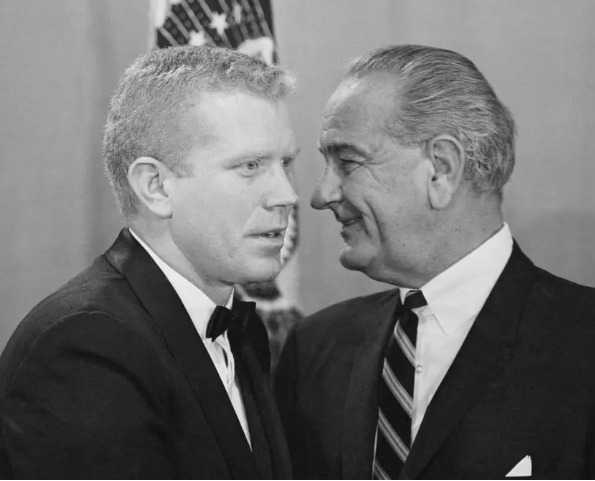
Ben Barnes (shown above, in his younger days, with President Lyndon Johnson) was a political wunderkind who became Speaker of the Texas House of Representatives in 1965, when he was only 26 years old.  Barnes, who later became Lieutenant Governor of Texas, received counsel from then-Governor John Connally while he was Speaker; both were Democrats but later became Republicans.  Connally, who had spent a million dollars on his campaign for the 1980 presidential nomination only to receive one delegate, hoped to get an appointment as Secretary of State or Secretary of Defense in a Reagan administration.
In an interview with the New York Times, Barnes says he accompanied Connally on a trip to the Middle East, where Connally told Arab leaders, “Look, Ronald Reagan's going to be elected President and you need to get the word to Iran that they’re going to make a better deal with Reagan than they are Carter. It would be very smart for you to pass the word to the Iranians to wait until after this general election is over."

Barnes also says that he and Connally also met with former Securities and Exchange Commission director William Casey, who was managing Reagan's 1980 general election campaign, to report the trip.  While Connally did not get either Cabinet position he was hoping for (and declined the post of Secretary of Energy, which went to - I am not making this up - a dentist), Casey became Reagan's CIA director; he eventually got involved in another scandal involving Iran - the Iran-contra affair - by a[proving illegal diversion of funds from Iran arms sales the Nicaraguan contras, being implicated by General Richard Secord in the Iran-contra hearings less then 24 hours before Casey died.
There are three conclusions to this story:
  • Reagan's outreach to Iran in his second term was tainted not by its secrecy but by his campaign's underhanded rigging of the 1980 election, so what I said in January 2020 no longer applies. 
  • This is as equally horrible as the story about Nixon rigging the 1968 election by telling the South Vietnamese not seek a deal to end the war in Vietnam with the Johnson administration with the promise of a better deal from a Nixon administration, because of the 42 years and counting of the far-right hold on the country's affairs.
  • We should be glad John Connally was never elected President.

Friday, January 8, 2021

Review: "Jimmy Carter: Rock and Roll President"

I like to refer to popular music in whatever else I'm talking about on this blog because popular music is the language with which I speak.  Popular music comes in handy to discuss social or political trends, for example.  Music is also how our 39th President, James Earl Carter, Jr., communicated.

"Jimmy Carter: Rock and Roll President" is a CNN film exploring how Carter embraced music in conveying his message and his principles as a presidential candidate and as President.  The film is a joyful, energetic look at a side of Carter that many of us forgot exists.  We hear stories from Carter himself, his son Chip, and his former aides - along with commentary from Bob Dylan, Willie Nelson, Gregg Allman (who died in 2017), and Nile Rodgers about how the President not only liked the music, he understood it.  It's a re-affirming celebration of American music, particularly seventies Southern rock, country and western, rhythm and blues, and jazz.  Even Carter's hairstyle symbolized a new, relaxed attitude reflecting the music he loved; as rock author Nicholas Schaffner once said, Carter in 1976 had as much hair as the Beatles did in 1964.  
Some priceless moments include President Carter providing the vocals at a White House jazz concert while Dizzy Gillespie plays "Salt Peanuts," Aretha Franklin performing "God Bless America" at Carter's 1977 inaugural gala, the story of Carter's deep friendship with the Allman Brothers Band, and a story from Willie Nelson about how he smoked pot with, it later was revealed Carter's son Chip in the White House.  President Carter clearly comes across as the man Nile Rodgers describes in this documentary as a President who saw the world the way musicians saw it.
The film notes, though, that this rock and roll Camelot couldn't last, as the economy soured and American embassy staffers in Iran were taken hostage.  Indeed, the rise of Ronald Reagan - whose greased-back, pre-Elvis hair and his indifference toward newer forms of music signaled a return to a Presidency out of touch with popular culture - pretty much slammed the door shut on this era.  (Reagan at least hosted Frank Sinatra and Marvin Hamlisch at the White House; I can't think of one musical performance ever hosted at 1600 Pennsylvania Avenue by the outgoing administration of Donald J. Trump.)  But this documentary is still a wonderful time capsule reminding us of what what was and what could be again.
Originally broadcast on January 3, "Jimmy Carter: Rock and Roll President" re-airs on Saturday, January 9 at 10 Eastern time on CNN. I presume it's also on On Demand.  I think I'll see it again. 😊  

Tuesday, October 23, 2018

Hell's Broke Loose In Georgia

And Georgia Secretary of State Brian Kemp deals the cards.
Kemp, whose job it is in Georgia to regulate statewide elections, has been using all sorts of tricks to keep, last time I checked, 30,000 people from voting in this year's gubernatorial election - all because a few names on the rolls are spelled wrong by a letter or two.  Kemp, a Republican, is apparently afraid that there will be too many Democrats going to to the polls and voting for Democratic gubernatorial candidate Stacy Abrams, pictured below. 
Now why would Brian Kemp be scared of a nice lady like this being elected governor of Georgia?
It's not because her name sounds Jewish, is it?
Oh, mercy me, where is my head?  It's because she's black - like 70 percent of the registered voters Kemp has purged from the rolls.  He's also dong this to strengthen the hand of the Republican gubernatorial candidate, who happens to be . . . Brian Kemp!
Abrams is promoting an agenda to make Georgia a fair, just state (note that I didn't say see was promoting and an agenda to make it "more" fair and just), and Kemp clearly believes that the worst thing Georgia could have is a black woman running the show.  I can think of something far worse - letting Brian Kemp run the show.  He makes Trump look civilized, what with his own anti-poor, anti-immigrant agenda.  He's promised to go out through Georgia and apprehend and deport illegal immigrants himself with his own pickup truck.
I must say, it took the Democrats guts to nominate a black woman for the highest office in the Peach State, but it may be paying off; early voting in Georgia has tripled over the number of voters in 2014.  Polls give Abrams a slight edge, although Nate Silver's FiveThirtyEight.com site rates the race as a toss-up.  After having tried and failed with running Jimmy Carter's grandson Jason for governor in 2014 and running Sam Nunn's daughter Michelle for the U.S. Senate that same year, Georgia Democrats are eschewing dynasty politics and trying something different, which may enable them to do something they haven't done in a long time - win an election.  (And also bear in mind that Jon Ossoff is Not.  Running. For Anything.  Again.)  But as long as Brian Kemp is calling the shots over how elections are run in Georgia, Abrams' election is anything but a guarantee.
Though, if he rigs the vote, at least Georgia has its own Jimmy Carter to monitor the recount. ;-)   

Sunday, January 1, 2012

Carteresque?

Barack Obama in 2012 is nothing like Jimmy Carter in 1980. Just because Obama is the most vulnerable incumbent President running for re-election since 1980 (according to the polls), just because he inherited a sluggish economy that has yet to fully recover, just because Iran is suddenly a bone of contention for him, just because fuel prices could suddenly go up as a result of an Iran-related crisis, just because it's been difficult if not impossible to borrow money in this country, just because his handling of Afghanistan is an issue, just because some voters personally like him but think he's in over his head, just because he has a million-watt smile . . .


. . . and just because there's a very good chance that Obama could lose the presidential election this year to an intellectually challenged, opportunistic Republican incompetent, that doesn't mean voters could think Obama's effort at changing the country for the better is all . . . peanuts.
But, unlike Carter, at least Obama wasn't frightened by a WHITE RABBIT!


Feed your ego, baby.  Happy new year. ;-)

Wednesday, July 15, 2009

Jimmy Carter's "Malaise" Speech

It was thirty years ago today that President Jimmy Carter delivered his speech on the crisis of confidence in the United States at the time. The economy was tanking, cities were dying, and a major oil shortage gripped the nation in the aftermath of a nuclear accident in Pennsylvania. (Worse was to come - Iran would hold American embassy staffers in Tehran hostage and the Soviet Union would invade Afghanistan.) Carter, noting the spiritual emptiness of American life, gave a speech that was more of a sermon than an address. (July 15, 1979, was, appropriately enough, a Sunday.) He called on the American people to find purpose in their lives, urged them to renounce pursuit of material wealth for its own sake, and asked them to demonstrate the faith he had in them to by recommitting themselves to the political and social foundations of America that he knew would endure.
Though the word never appeared in the text, it was called the "malaise" speech.
Although Carter appealed to the better angels of the nature of Americans, the tone and cadence of his words suggested that he found fault in the behavior of Americans and suggested they had no great goals beyond living "the good life." Americans don't like to be lectured to, and they responded to Carter's speech by electing Ronald Reagan, a man devoted to preserving the good life at the expense of the American political and social fabric Carter found unraveling. Carter let Americans know that their excessive living patterns had to be scaled back and they had to get more serious about their lives.
As James Howard Kunstler wrote, Carter told Americans the truth and they hated them for it.
Today, we're trying to overcome another crisis of confidence as we attempt to recover from the worst recession in sixty years. President Obama, like Carter before him, prefers to talk to the American people like adults. This time we appear to be ready to listen.